


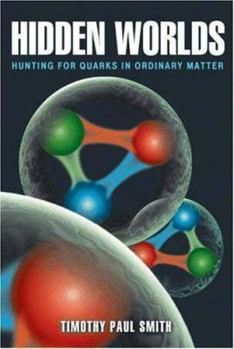
Hidden Worlds: Hunting for Quarks in Ordinary Matter


Select Format
Select Condition 
Book Overview
No one has ever seen a quark. Yet physicists seem to know quite a lot about the properties and behavior of these ubiquitous elementary particles. Here a top researcher introduces us to a fascinating but invisible realm that is part of our everyday life. Timothy Smith tells us what we know about quarks--and how we know it. Though the quarks that make science headlines are typically laboratory creations generated under extreme conditions, most quarks occur naturally. They reside in the protons and neutrons that make up almost all of the universe's known matter, from human DNA to distant nebulae, from books and tables to neutron stars. Smith explains what these quarks are, how they act, and why physicists believe in them sight unseen. How do quarks arrange themselves? What other combinations can nature make? How do quarks hold nuclei together? What else is happening in their hidden worlds? It turns out that these questions can be answered using a few simple principles, such as the old standby: opposites attract. With these few principles, Smith shows how quarks dance around each other and explains what physicists mean when they refer to "up" and "down" quarks and talk about a quark's color, flavor, and spin. Smith also explains how we know what we know about these oddly aloof particles, which are eternally confined inside larger particles. He explains how quark experiments are mounted and how massive accelerators, targets, and detectors work together to collect the data that scientists use to infer what quarks are up to. A nonmathematical tour of the quark world, this book is written for students, educators, and all who enjoy scientific exploration--whether they seek a taste of subnuclear physics or just wonder about nature on the smallest of scales.
Format:Hardcover
Language:English
ISBN:0691057737
ISBN13:9780691057736
Release Date:December 2002
Publisher:Princeton University Press
Length:192 Pages
Weight:1.15 lbs.
Dimensions:9.5" x 0.8" x 6.3"
Customer Reviews
1 rating
An excellent introduction to the quark hypothesis
Published by Thriftbooks.com User , 22 years ago
This book provides an overview of what basic quark theory is and how it came to be from both a historical and a logical point of view. Although it's a short book, a lot of ground is covered. There is a fair amount of theory and there are dips into the particulars of high energy physics experimental apparatus. The chosen topics are interesting in themselves and they lead step by step to the endpoint of the book.While there are a number of technical physics terms (e.g. spin, cross section), I was pleasantly surprised that the book presented very useful analogies describing what the terms represent. Whereas, in many books the spin of a particle is often visualized as the spin of a planet or a top and left at that, here spin is likened to the spin of a billiard ball as it collides with a cushion AND thus affects the angle at which the ball (or particle) rebounds. It's still hard to visualize how these tiny particles can "spin", but that's not really what's important. What is important is the measurable collision effects which can then be represented as if the particles had a spin. Once you know the effect, then you can visualize some familiar thing to help you picture the effect.I have a physics background, so for me the book provided a overarching framework that tied together many concepts that I knew fairly well in isolation. It also provided me with some very appealing visual models, that somehow I never had seen before.Would the book be of sufficient interest to those without a physics background? I would like to think so, but you have to keep in mind the scope of the book. The quark hypothesis, especially when theory and experiment are taken into account, is a massive topic. Just the history of the development of quark theory has spawned books of 300 or more pages. After reading this book, will you become an expert in spin statistics? Or modern day experimental apparatus? Or quarks and gluons? No. But that's not the aim of the book. It simply provides a nice overview, presented in a logical fashion with each part leading to the next, that will give you some inkling of what this stuff is all about and how it all fits together. There are some tougher parts where unusual concepts are briefly discussed, but the level of detail is only that which is necessary to further the discussion. As such, some topics may very well remain somewhat mysterious. But don't let that discourage you. If after reading you only have a vague picture of, say, "spin", then that's OK. At least you will know a bit of how why it's important. And if the tougher parts spur you to dig deeper into those topics, so much the better. Either way, the book has done its job.While there is a nice glossary of terms, it is most unfortunate that there are no suggestions leading the way to deeper reading. In my opinion, the lack of a bibliography mars what would have otherwise been a 5 star book.
Copyright © 2026 Thriftbooks.com
Terms of Use | Privacy Policy | Do Not Sell/Share My Personal Information | Cookie Policy | Cookie Preferences | Accessibility Statement
ThriftBooks ® and the ThriftBooks ® logo are registered trademarks of Thrift Books Global, LLC
ThriftBooks ® and the ThriftBooks ® logo are registered trademarks of Thrift Books Global, LLC
