


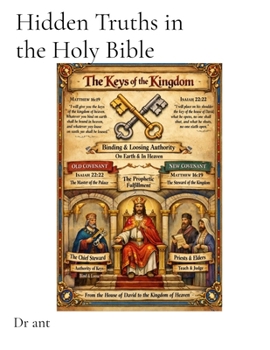
Hidden Truths in the Holy Bible

In the long annals of human literature - from the libraries of Alexandria to the digital
archives of the modern age - no text has ever been demonstrated to operate
simultaneously on multiple independent encoding systems, across thousands of years of
composition, authored by dozens of different individuals, in multiple languages, and yet
maintain perfect mathematical, prophetic, typological, and linguistic coherence
throughout. No text, that is, except one.
The Holy Bible is, by every measurable standard, the most structurally complex,
mathematically precise, prophetically verified, and lexically layered document in human
history. This is not a devotional claim. It is a demonstrable, falsifiable, scholarly
observation.
"For I tell you, until heaven and earth disappear, not the smallest letter, not the least stroke
of a pen, will by any means disappear from the Law until everything is accomplished."-
Matthew 5:18 (NIV)
Consider what must be true simultaneously for the Bible to exist as it does:
1. Seventy-Three bookswritten across approximately 1,500 years (roughly 1400 BC
to AD 95)
2. Forty or more human authors from wildly different walks of life: shepherds,
kings, fishermen, tax collectors, military commanders, physicians, and prophets
3. Three languages: Classical Hebrew, Aramaic, and Koine Greek
4. Three continents: Asia, Africa, and Europe
5. Multiple encoding systems operating simultaneously, each independently
verifiable
Those seven encoding systems - each of which this volume documents in full - are:
1. Pictographic Encoding - Every Hebrew letter was originally a picture; words
encode their meaning in the images of their letters
2. Numerical Encoding (Gematria) - Every Hebrew and Greek letter carries a
numerical value; connections between identical values reveal theological
relationships
3. Structural Encoding (Chiasmus) - Passages, chapters, and entire books are
structured as mirror-image literary architectures, with the theological center at the
pivot point
4. Prophetic Encoding- Over 300 specific, datable prophecies about the Messiah
alone, all demonstrably fulfilled in a single historical person
5. Typological Encoding - Persons, events, objects, and institutions in the Old
Testament serve as exact pre-figurements of New Testament realities, with
multiple precise correspondences
6. Acrostic & Alphabetic Encoding - Divine names, words, and concepts hidden
at mathematically precise letter-skip intervals throughout the text
7. Calendrical & Feast Encoding - The seven appointed Feasts of the LORD serve
as a prophetic calendar, with the first four fulfilled on their exact dates within the
first century AD
No human conspiracy could have engineered this. The authors did not know one another.
Most of the New Testament was written by authors who never saw the Old Testament in
its completed form. The probability calculations required to account for these patterns by
chance exceed the total number of atoms in the observable universe. This is not
hyperbole - the mathematics will be presented in full in the chapters that follow
Customer Reviews
ThriftBooks ® and the ThriftBooks ® logo are registered trademarks of Thrift Books Global, LLC
