


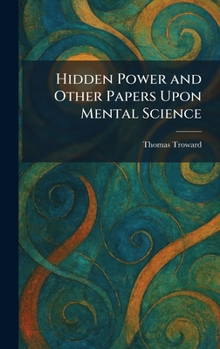
Hidden Power and Other Papers Upon Mental Science

"Hidden Power and Other Papers Upon Mental Science" is a foundational collection of essays by the influential New Thought philosopher Thomas Troward. In this work, Troward explores the profound relationship between the individual mind and the Universal Mind, offering a logical and scientific approach to spiritual principles. The text examines the "hidden power" that resides within every human being-the creative faculty of thought that allows individuals to manifest their reality and align themselves with divine laws.
Spanning topics such as the nature of spirit, the creative process, and the practical application of mental science, these papers provide a bridge between traditional theology and modern metaphysics. Troward's insights into the subconscious mind and the law of attraction serve as a guide for personal growth and spiritual enlightenment. His writing is characterized by a unique blend of analytical rigor and deep spiritual conviction, making complex concepts accessible to those seeking to unlock their inner potential. "Hidden Power and Other Papers Upon Mental Science" remains a timeless resource for students of metaphysics, self-help, and the transformative capacity of the human spirit.
This work has been selected by scholars as being culturally important, and is part of the knowledge base of civilization as we know it. This work was reproduced from the original artifact, and remains as true to the original work as possible. Therefore, you may see the original copyright references, library stamps (as most of these works have been housed in our most important libraries around the world), and other notations in the work.
This work is in the public domain in the United States of America, and possibly other nations. Within the United States, you may freely copy and distribute this work, as no entity (individual or corporate) has a copyright on the body of the work.
As a reproduction of a historical artifact, this work may contain missing or blurred pages, poor pictures, errant marks, etc. Scholars believe, and we concur, that this work is important enough to be preserved, reproduced, and made generally available to the public. We appreciate your support of the preservation process, and thank you for being an important part of keeping this knowledge alive and relevant.
Customer Reviews
ThriftBooks ® and the ThriftBooks ® logo are registered trademarks of Thrift Books Global, LLC
