


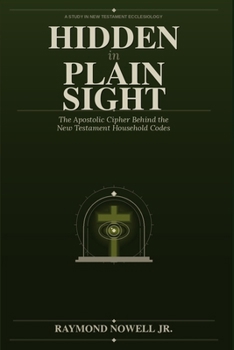
Hidden in Plain Sight: The Apostolic Cipher Behind the New Testament Household Code

The apostles were writing under surveillance - and they knew it.
When Pliny the Younger interrogated Christians in AD 112, he was attempting to map their organizational structure in order to dismantle it. The apostles had anticipated exactly that threat decades earlier.
The New Testament household codes - the Haustafeln of Colossians, Ephesians, 1 Peter, and the Pastoral Epistles - have long been debated for their social ethics. But a prior question has gone largely unanswered: Why do they exist in this form, in these letters, at this moment in history?
Raymond Nowell Jr. proposes that the Haustafeln operated on a double register: presenting conventional Greco-Roman household ethics on the surface while encoding apostolic instruction about ecclesial structure beneath - legible to insiders, invisible to Rome.
ABOUT THE AUTHOR
Raymond Nowell Jr. serves as Pastor of Children's Ministry at Willow Bend Church in Plano, Texas, and studied at Dallas Theological Seminary. He is also the author of the devotional commentary series Good News for Broken and Sinful People.
Customer Reviews
ThriftBooks ® and the ThriftBooks ® logo are registered trademarks of Thrift Books Global, LLC
