


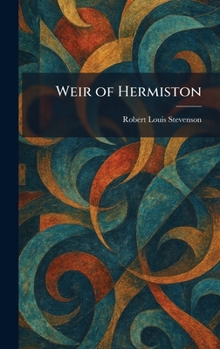
Weir of Hermiston

Select Format
Select Condition 
Book Overview
"Weir of Hermiston" is widely considered Robert Louis Stevenson's unfinished masterpiece. Set against the rugged backdrop of the Scottish Lowlands in the late 18th century, the novel tells the story of Archie Weir, the sensitive son of the stern and ruthless judge Adam Weir, known as the Lord Justice-Clerk. This work explores the profound psychological and moral tensions between a father's rigid adherence to the law and a son's burgeoning sense of justice and emotion.
The narrative follows Archie as he is banished to the remote village of Hermiston after publicly denouncing his father's harsh sentencing. There, he falls in love with Christina Elliott, leading to a tragic series of events involving family honor, social duty, and betrayal. Stevenson's prose in this work is celebrated for its mastery of the Scots dialect and its deep psychological insight, marking a transition toward a more mature and somber style. Although the work remains incomplete, the existing chapters are regarded as some of the finest examples of Scottish fiction, blending historical realism with the intensity of a Greek tragedy. This powerful tale of conflict and consequence remains a vital piece of the Western literary canon.
This work has been selected by scholars as being culturally important, and is part of the knowledge base of civilization as we know it. This work was reproduced from the original artifact, and remains as true to the original work as possible. Therefore, you may see the original copyright references, library stamps (as most of these works have been housed in our most important libraries around the world), and other notations in the work.
This work is in the public domain in the United States of America, and possibly other nations. Within the United States, you may freely copy and distribute this work, as no entity (individual or corporate) has a copyright on the body of the work.
As a reproduction of a historical artifact, this work may contain missing or blurred pages, poor pictures, errant marks, etc. Scholars believe, and we concur, that this work is important enough to be preserved, reproduced, and made generally available to the public. We appreciate your support of the preservation process, and thank you for being an important part of keeping this knowledge alive and relevant.
Customer Reviews
Unfinished, but excellent
ThriftBooks ® and the ThriftBooks ® logo are registered trademarks of Thrift Books Global, LLC
