


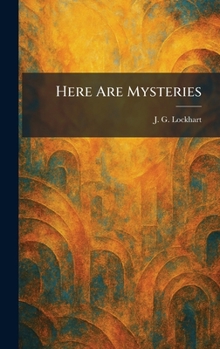
Here Are Mysteries

"Here Are Mysteries" is a captivating exploration into some of the most enduring and baffling enigmas of history. This collection delves into a series of unsolved cases that have piqued the curiosity of scholars and the public for generations. From the strange disappearance of the crew of the "Mary Celeste" to the identity of the "Lost Dauphin" of France, the work examines the evidence and theories surrounding these legendary events.
The book also investigates the mysterious appearance of Kaspar Hauser, the fate of the Archduke Salvator of Austria, and several other historical puzzles. J.G. Lockhart brings a keen investigative eye to these stories, balancing historical facts with the various myths that have grown around them over time. By revisiting original accounts and weighing conflicting testimonies, "Here Are Mysteries" offers a thoughtful look at how certain events remain shrouded in uncertainty despite the passage of years.
This work remains a significant contribution to the literature of historical mysteries, providing readers with a detailed overview of cases that continue to challenge our understanding of the past. It is an essential read for those fascinated by the intersection of history, folklore, and the unexplained.
This work has been selected by scholars as being culturally important, and is part of the knowledge base of civilization as we know it. This work was reproduced from the original artifact, and remains as true to the original work as possible. Therefore, you may see the original copyright references, library stamps (as most of these works have been housed in our most important libraries around the world), and other notations in the work.
This work is in the public domain in the United States of America, and possibly other nations. Within the United States, you may freely copy and distribute this work, as no entity (individual or corporate) has a copyright on the body of the work.
As a reproduction of a historical artifact, this work may contain missing or blurred pages, poor pictures, errant marks, etc. Scholars believe, and we concur, that this work is important enough to be preserved, reproduced, and made generally available to the public. We appreciate your support of the preservation process, and thank you for being an important part of keeping this knowledge alive and relevant.
Customer Reviews
ThriftBooks ® and the ThriftBooks ® logo are registered trademarks of Thrift Books Global, LLC
