


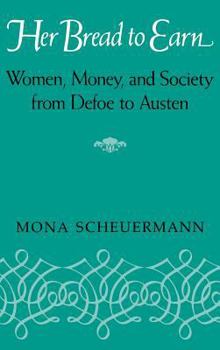
Her Bread to Earn

" Her Bread to Earn focuses on the images presented by the major novels of the eighteenth and early nineteenth century, those works that form the core of the canon or that define an important trend at a particular time. Moving through Defoe through Richardson, Fielding, Holcroft, Godwin, Bage, Inchbald, and Wollstonescaft to Austen, Scheuermann demonstrates that novelists of this period depicted women as relatively independent persons, many of whom managed property, shaped and directed events, a
Format:Hardcover
Language:English
ISBN:0813118174
ISBN13:9780813118178
Release Date:April 1993
Publisher:University Press of Kentucky
Length:296 Pages
Weight:1.40 lbs.
Dimensions:1.0" x 6.3" x 9.4"
Grade Range:Postsecondary and higher
Customer Reviews
1 rating
An outstanding book for feminist scholars of the Regency
Published by Thriftbooks.com User , 26 years ago
This book is written by an English professor from Illinois who has closely examined images of women in the eighteenth-century English novel. As a result of her research, the author has concluded that women are depicted as "strong, capable and responsible members of society in a surprising variety of works" by major male and female novelists of eighteenth-century England. Scheuermann believes that other scholars who have examined the literature of the eighteenth century in the past have put too much emphasis on woman as "a nonfunctioning member of society, essentially excluded from any but the role of sufferer." In addition, the author offers the following fascinating quote, which represents one of the major premises of her book: "Relatively few eighteenth-century female characters spend much time worrying about their virginity. There is much more concern with making a living--whether the woman is single, which means finding money to live, or married, which implies managing finances." Scheuermann states that a frequent theme in eighteenth-century novels is the inability of men to manage money and how wives try to deal with that harrowing problem. She claims that Austen's Pride and Prejudice has a strong financial base and that in Emma, as well, finances are virtually synonymous with matrimonial pairings. In addition, the author doesn't agree with traditional interpretations of Richardson's Pamela and Clarissa as being defenses of virtue. She believes they, as much as Austen's works, are also "money centered." Scheuermann believes that the world of eighteenth-century women in English novels is not so terribly restricted as the current scholarly "misemphasis" on chastity implies. She feels that women "get away with quite a lot" in these books. They leave home a great deal, are not always very well chaperoned, often have extraordinary adventures, and the world is not perceived as horribly dangerous by them. In fact, if a young woman comes to harm, it is usually at the hands of someone she knows. (Very much in keeping with what we know these days statistically about rape.)The author points out that the themes in British eighteenth-century novels are very different than American ones. In American fiction of that era, the slightest mis-step on the part of a female character leads to "irreparable loss and imminent death." Female characters in American novels who "deliberately or accidentally venture beyond the bounds of polite behavior...die in droves...for the very smallest of peccadilloes." In contrast, in all but the most "sentimental" British fiction, women are "quite robust." Importantly, the author distinguishes between the social patterns in novels and the real-life legal situation of women in the eighteenth century as well as the extremely limited employment options they had. She comments on the well-known fact that widows and women who are unmarried and unbetrothed could control their property and money, b
Copyright © 2026 Thriftbooks.com Terms of Use
| Privacy Policy | Do Not
Sell/Share My Personal Information | Cookie Policy | Cookie Preferences | Accessibility Statement
ThriftBooks® and the ThriftBooks® logo are registered trademarks of Thrift Books Global, LLC
ThriftBooks® and the ThriftBooks® logo are registered trademarks of Thrift Books Global, LLC
