


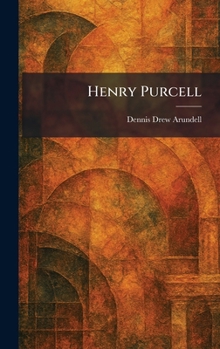
Henry Purcell

"Henry Purcell" offers an insightful and scholarly examination of one of England's greatest musical geniuses. Written by the esteemed musician and researcher Dennis Arundell, this work delves into the life and career of the Restoration composer who defined a unique era of English music. The book provides a detailed exploration of Purcell's evolution, from his early years as a chorister to his heights as a composer for the Chapel Royal and the theater.
Arundell meticulously analyzes Purcell's vast output, including his influential operas like "Dido and Aeneas," his mastery of the semi-opera genre, and his profound contributions to sacred and instrumental music. By situating Purcell within the cultural and political landscape of 17th-century England, the author clarifies why his innovations in harmony and word-setting remained unmatched for generations. This study serves as both an essential biography for music historians and an accessible guide for enthusiasts looking to understand the technical brilliance and emotional depth of Purcell's compositions.
With a focus on the structural integrity and artistic legacy of the music itself, this book remains a significant contribution to the study of the Baroque period. It captures the essence of a composer whose work continues to resonate in concert halls and cathedrals around the world.
This work has been selected by scholars as being culturally important, and is part of the knowledge base of civilization as we know it. This work was reproduced from the original artifact, and remains as true to the original work as possible. Therefore, you may see the original copyright references, library stamps (as most of these works have been housed in our most important libraries around the world), and other notations in the work.
This work is in the public domain in the United States of America, and possibly other nations. Within the United States, you may freely copy and distribute this work, as no entity (individual or corporate) has a copyright on the body of the work.
As a reproduction of a historical artifact, this work may contain missing or blurred pages, poor pictures, errant marks, etc. Scholars believe, and we concur, that this work is important enough to be preserved, reproduced, and made generally available to the public. We appreciate your support of the preservation process, and thank you for being an important part of keeping this knowledge alive and relevant.
Customer Reviews
ThriftBooks ® and the ThriftBooks ® logo are registered trademarks of Thrift Books Global, LLC
