


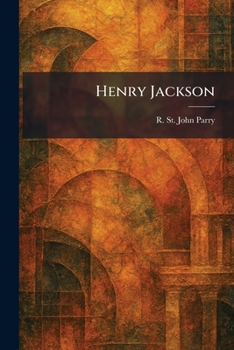
Henry Jackson

Select Format
Select Condition 
Book Overview
Henry Jackson is a comprehensive biographical study of one of the most influential figures in the history of British classical scholarship. Written by R. St. John Parry, a close colleague at Trinity College, Cambridge, this work offers a profound look into the life and intellectual contributions of a man who served as the Regius Professor of Greek. Jackson was not only a distinguished scholar of ancient philosophy but also a pivotal administrative force within the University of Cambridge during a period of significant reform and growth.
The narrative explores Jackson's dedication to his students, his deep-seated love for the classics, and his role in shaping the academic culture of his era. Through personal recollections and detailed accounts of his academic pursuits, the book captures the essence of a Victorian intellectual whose influence extended far beyond the walls of the lecture hall. Readers will find a meticulous portrait of a man defined by his integrity, his passion for Greek literature, and his unwavering commitment to higher education. This biography serves as an essential record for those interested in the history of the University of Cambridge, the development of classical studies, and the lives of the great Victorian and Edwardian educators.
This work has been selected by scholars as being culturally important, and is part of the knowledge base of civilization as we know it. This work was reproduced from the original artifact, and remains as true to the original work as possible. Therefore, you may see the original copyright references, library stamps (as most of these works have been housed in our most important libraries around the world), and other notations in the work.
This work is in the public domain in the United States of America, and possibly other nations. Within the United States, you may freely copy and distribute this work, as no entity (individual or corporate) has a copyright on the body of the work.
As a reproduction of a historical artifact, this work may contain missing or blurred pages, poor pictures, errant marks, etc. Scholars believe, and we concur, that this work is important enough to be preserved, reproduced, and made generally available to the public. We appreciate your support of the preservation process, and thank you for being an important part of keeping this knowledge alive and relevant.
Customer Reviews
ThriftBooks® and the ThriftBooks® logo are registered trademarks of Thrift Books Global, LLC
