



Select Format
Select Condition 
Book Overview
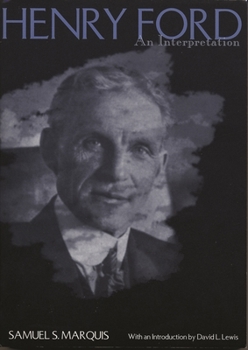
A reprint of the rare and controversial biography of Henry Ford, first published in 1923, written by Ford's close associate.
Regarded by many automotive historians as the finest and most dispassionate character study of Henry Ford ever written, Henry Ford: An Interpretation has long been out of print and priced out of the reach of many collectors. Published at the height of Ford's success in 1923, the volume was written by the Reverend Samuel S. Marquis, an Episcopalian minister who was also the head of the sociology department at Ford Motor Company. Instead of a history of Ford Motor Company or a simple retelling of Ford's life story, Marquis claims that his collection of essays is intended to analyze the "psychological puzzle such as the unusual mind and personality of Henry Ford presents."
In insightful chapters that can be read in any order, Marquis examines Ford's mastery of self-promotion, his invincible reputation, his religious views, and his "elusive" personality. He also considers Ford through the lens of his corporation by commenting on its industrial operations, its charitable causes, and its "executive scrap heap." According to many accounts, Henry Ford was greatly pained by the criticism in some of Marquis's essays, which led him to suppress the wide distribution of the volume. Indeed, so many copies of Henry Ford: An Interpretation were borrowed from the Detroit Public Library and never returned that the library was forced to remove the volume from its shelves. Not surprisingly, the original edition of this book is very expensive and hard to find as a result of these sorts of actions.
Ford history enthusiasts as well as readers who are interested in historical biography will be grateful for the reprint of this significant volume.
Customer Reviews
ThriftBooks ® and the ThriftBooks ® logo are registered trademarks of Thrift Books Global, LLC
