


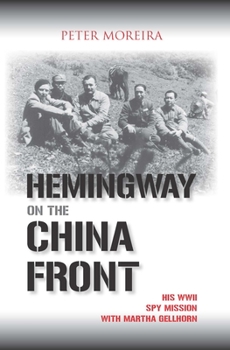
Hemingway on the China Front: His WWII Spy Mission with Martha Gellhorn

Select Format
Select Condition 
Book Overview
Ernest Hemingway and Martha Gellhorn had no idea of what they would discover when they set out for Hong Kong, China, and Burma in 1941. The husband-and-wife team of celebrity literati intended to report on the China-Japan war while honeymooning in the romantic Far East. What they found was a maddening, intriguing, colorful world of dictators and drunks, scoundrels and socialites, heroes and halfwits. And their trip proved to be the beginning of the end of their marriage.When the U.S. Treasury Department hired Ernest Hemingway as a spy in China in 1941, it awakened a new obsession in America's most adventuresome author. The great literary man of action reveled in being a government operative, while his journalist wife championed the anti-Japanese resistance of Chiang Kai-shek. Hemingway on the China Front is the first book to track Hemingway's progress as a spy in Asia during the war, defining his duties as he saw fit. Author Peter Moreira follows Hemingway and Gellhorn as they seek stories to file--and try to adapt to each other's strong egos--in dangerous, uncomfortable, exotic places in the throes of war. Well-versed in Asian history and culture, Moreira also adeptly provides context of time and place. All fans of Ernest Hemingway and Martha Gellhorn will want this book.
Format:Paperback
Language:English
ISBN:157488882X
ISBN13:9781574888829
Release Date:October 2007
Publisher:Potomac Books
Length:256 Pages
Weight:0.88 lbs.
Dimensions:0.7" x 6.1" x 8.9"
Customer Reviews
3 ratings
Ernest and Martha's Excellent Adventure
Published by Thriftbooks.com User , 18 years ago
In a short book about a few months in the lives of Ernest Hemingway and Martha Gellhorn, Canadian journalist Peter Moreira has managed to give us a portrait of the two writers as they really were. Hemingway on the China Front shows us the pair at their journalistic peaks and valleys, their relationship at its most romantic and as it starts to disintegrate, and two individuals coping gracefully and not so gracefully under trying circumstances. Let's get this "spy" business out of the way. It's a good title and it may capture a few readers who'll think "I didn't know Hemingway was a spy!" Hemingway and Gellhorn were going to Asia (China, Burma, Hong Kong, the Dutch East Indies) as journalists. It was no secret that they would be digging for information. They were both well-known war reporters, and would therefore be looking for war-related intelligence. Even if they hadn't already been famous, they would have stuck out in Asia like sore thumbs, Hemingway for his height and Gellhorn for being blond. Any undercover work was out of the question. Hemingway was asked by the U.S. Treasury Department to check of the transportation situation in China, to gauge how the money the U.S. was sending China was being spent. Gellhorn was a friend of the Roosevelts and was a regular White House visitor. While there's no evidence that she too was asked to check up on the Chinese, she could be expected to be debriefed when she returned to the States. Moreira tells a quick-paced story of two young and glamorous war reporters on a trip to exotic lands while the war is getting underway. They were newlyweds as well, although they'd been together for several years. While they jokingly referred to the trip as their honeymoon, the only parts of the trip that might have qualifed were the initial stop in Hawaii and their stay in Hong Kong. The rest of the trip reads like an endurance test. The conditions in China were filthy and crowded. It was a huge dose of culture shock for the pair, and they handled it in different ways. Hemingway stayed drunk as much as possible. Gellhorn was learning that living with an alcoholic could be exhilarating at its best and unbearable at its worst. Even after they broke up and she refused for the most part to talk or write of him, she admitted that the best times of her life were with Hemingway. And the worst. Moreira explains clearly the political situation in China and we're able to appreciate the dilemma that the writers faced in trying to support the U.S. allies represented by Chiang Kai-Shek and Chou En-Lai, while not ignoring the repressive regimes they controlled. They weren't entirely successful. Hemingway on the China Front, for all its attention to journalistic detail and scholarship, also has a large helping of entertaining stories. The two met some fascinating characters in Asia including Emily Hahn, several dashing American pilots, Chou En-Lai and Madame Chiang Kai-Shek. And Moreira re-tells some of the best stories from Gell
Excellent in Every Respect
Published by Thriftbooks.com User , 19 years ago
This is a surprisingly good book. Peter Moriera apparently has no other books to his credit, nor is a literary scholar, yet nevertheless delivers a smooth brisk text that is fact-filled. It is carefully documented with honest, substantive footnotes that demonstrate original research. It is also just a good straight piece of storytelling about a fascinating adventure at an important juncture of modern history: while Hitler was attacking Britain, Japan was conquering the East, but before America was involved in either front. This would be a great reading experience whoever was at the center of it, but the writing team of Hemingway and Gellhorn offers the opportunity for drama and shrewd but carefully fair character study. Indeed all the principals including their Chinese interpreters, state department figures, Hemingway's drinking pals, Generalissimo and Mrs. Chiang Kai-Shek, Chou En-lai, are presented in fair, balanced, and fully rounded portaiture. The depiction of Hemingway and Gellhorn is a miracle of balance and fairness. The book does not take sides or have any agenda. It presents the strengths of each from an informed and sympathetic perspective, their respective flaws with realism and wry detatchment. Truth be told, by focusing on a fixed episode of Hemingway's life late 1940 through 41, Moreira is able to deliver one of the best portraits in life of Hemingway to date, superior indeed to many first person accounts. To those who may not have known Gellhorn's work as well, a reading of this book will only leave you wanting to see more. Finally, the subject matter is not just a lark like an Indiana Jones adventure. Moreira illustrates how the two writers were subtly enlisted on behalf of the Roosevelt administration both to get over and "spy" undercover as reporters, but also to deliver something of its message afterwards. How both Hemingway and Gellhorn managed to do that as each, in their own way, preserved a degree of integrity and truth-telling is the real underside of the iceberg here awainting discovery.
Excellent Report of a Little Known World War II Incident
Published by Thriftbooks.com User , 19 years ago
Hemingway and Martha Gellhorn met in Spain as they were covering the Spanish Civil War. They were married in 1940. In 1941 they accepted a mission at the request of the US Government to make a trip to China. They also agreed to write articles for various magazines on their trip. The Government official largely responsible for getting them to make this trip was Harry Dexter White, later identified as a Soviet agent. It is interesting in that Hemingway was visiting an area where the Chinese Communists were trying to take over the country. It was a rough trip. This was the time of the Japanese invasion of China, it was the time of Mao Tse-Tung and Chiang Kai-Shek. It was not the time or place to take a pleasure trip. This was also well past Hemingway's prime writing period as he was declining into depression and alcoholism. It was a hard trip on their marriage, and by the end of the trip the marriage was basically over althouch Martha Gellhorn held on for another few years before divorcing him (the only one of his wives to leave him). This is a well written, well researched book that covers a little known incident in World War II history.
Copyright © 2026 Thriftbooks.com Terms of Use
| Privacy Policy | Do Not
Sell/Share My Personal Information | Cookie Policy | Cookie Preferences | Accessibility Statement
ThriftBooks® and the ThriftBooks® logo are registered trademarks of Thrift Books Global, LLC
ThriftBooks® and the ThriftBooks® logo are registered trademarks of Thrift Books Global, LLC
