


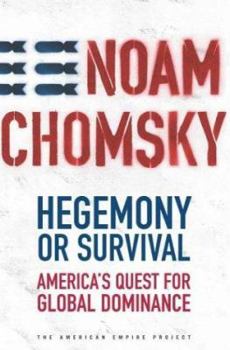
Hegemony or Survival: America's Quest for Global Dominance
(Part of the American Empire Project Series)

Select Format
Select Condition 
Book Overview
From the world's foremost intellectual activist, an irrefutable analysis of America's pursuit of total domination and the catastrophic consequences that are sure to follow The United States is in the process of staking out not just the globe but the last unarmed spot in our neighborhood-the heavens-as a militarized sphere of influence. Our earth and its skies are, for the Bush administration, the final frontiers of imperial control. In Hegemony or Survival , Noam Chomsky investigates how we came to this moment, what kind of peril we find ourselves in, and why our rulers are willing to jeopardize the future of our species. With the striking logic that is his trademark, Chomsky dissects America's quest for global supremacy, tracking the U.S. government's aggressive pursuit of policies intended to achieve "full spectrum dominance" at any cost. He lays out vividly how the various strands of policy-the militarization of space, the ballistic-missile defense program, unilateralism, the dismantling of international agreements, and the response to the Iraqi crisis-cohere in a drive for hegemony that ultimately threatens our survival. In our era, he argues, empire is a recipe for an earthly wasteland. Lucid, rigorous, and thoroughly documented, Hegemony or Survival promises to be Chomsky's most urgent and sweeping work in years, certain to spark widespread debate.
Format:Hardcover
Language:English
ISBN:0805074007
ISBN13:9780805074000
Release Date:August 1970
Publisher:Holt & Company, Henry
Length:288 Pages
Weight:1.23 lbs.
Dimensions:1.0" x 6.5" x 9.5"
Customer Reviews
4 ratings
revelations
Published by Thriftbooks.com User , 20 years ago
If you want to know why our actions in Iraq and elsewhere are just the tip of the iceberg then read what Noam has to say.
Superb Scholarship, Impeccable Research
Published by Thriftbooks.com User , 22 years ago
Noam Chomsky has done it again. With his latest book, "Hegemony or Survival, America's Quest for Global Dominance," Chomsky presents a thorough, meticulously-researched indictment of prevailing American foreign policy - a policy which, as Chomsky correctly observes, is sure to lead to disaster for not only the United States, but ultimately, the entire world. Chomsky vividly illustrates the great alarm that is now pervasive even among the American foreign policy establishment as it struggles to come to terms with an administration that has so recklessly endangered American national security through its single-minded focus on securing a global "Pax Americana." As far-fetched as these claims may sound to many, Chomsky's documentation is irrefutable, and his research impeccable. Chomsky provides an even-headed critique of our current course through a rational examination of the frightening consequences that are sure to follow.While his detractors are sure to resort to their usual accusations of virulent, knee-jerk anti-Americanism, asking any of them to substantiate their utterly baseless (and woefully ignorant) allegations through actually refuting the vast amounts of factual evidence Chomsky cites in his endnotes will prove to be nothing more than an exercise in futility - Chomsky's analysis is formidable, and it rests on a remarkable synthesis of practically-undeniable evidence.I'd recomend this book highly for anyone seeking to put the policies of the second Bush administration into a more fitting historical context. It is only through analyzing our current course in a post-September 11th world through this wider historical context that we find ourselves properly equipped to dissect the mindset of the current administration's foreign policy apparatus and the inevitable implications of its unabashed quest for global domination.
A summary of Chomsky's view, backed by current information
Published by Thriftbooks.com User , 22 years ago
During the 1990s, quite a few Chomsky books were compilations of previously-published material. He built books out of transcripts of talks, long interviews, and articles from Z magazine. Those books are all very good, but many of them had a scattered feel to them. In "Hegemony or Survival," he returns to the days when he sits at the typewriter and pounds out a new book.This time, Chomsky sums up over 30 years of research on US foreign policy. He uses the current war in Iraq and the history of our policy toward Cuba as his key cases. That's not to say he leaves out other countries. In fact, this book mentions one country after another in which the US government worked hard to overthrow democracy abroad while covering it up at home. But, by putting emphasis on Cuba and Iraq, Chomsky shows the consistency of US policy --- the methods, the tactics, the justifications, and the effects.It's the wide range of information that makes the book so convincing. Chomsky doesn't write opinion pieces. He presents you with a flood of facts, fully documented, and allows those facts to convince you. As you read, you'll say "Wow. Is that really true?" and flip to the footnotes. You'll find credible sources every time. You'll shake your head, wondering how you could have missed such important information. At some point, you end up reading with a finger wedged in the footnote section, flipping back and forth and making mental notes to double-check some of those sources later.If you haven't read Chomsky before, start with one of the better interview books such as "Understanding Power" and "Chronicles of Dissent." Then read this one. If you want to understand "Why do they hate us?" (and why that isn't even the right question to ask), Chomsky has the answers.
Topsy Turvy And All Too True
Published by Thriftbooks.com User , 22 years ago
To read Chomsky's HEGEMONY OR SURVIVAL is to visit a world turned upside down. A world where the characterization by U.S. elites of the 90s as the "decade of humanitarian intervention" is sharply questioned, it's also a place where interventions in the name of the "war on terror" are shown to be just the latest manifestations of an expansionist U.S. administration determined to hold onto long-range strategic imperatives, to disable rival systems and people that threaten its imperial objectives, and to strictly enforce its true animating principle -- the pro-market, anti-human ethos of the neo-liberal economic system. In other words, it's not the fumigated middle-school version of US foreign policy offered to Americans on TV Readers accustomed to the usual sycophantic justifications of U.S. foreign and policy may have a difficult time with Chomsky's remapping of recent political history. Those on the right will reject it as a Chomskyite confabulation. Moderates will wonder why he seems to hate America so much. Those on the left will be upset that the policies of Democrats are seen as little different from that of Republicans. Chomsky sees the two parties as nearly indistinguishable, calling them the two "business parties, one slightly less reactionary than the other." And here's Chomsky quoting Dewey on the narrow U.S. political spectrum.: "...John Dewey scarcely exaggerated when he described politics as 'the shadow cast on society by big business.' One of his main themes is that the United States, like its imperial predecessor, Great Britain, employs an idealizing and utopian language (the language of democracy and freedom) to justify its opposition to and extirpation of any countervailing force, even those founded upon the democratic or populist impulse, e.g., Nicaragua, Guatemala. This is not, of course, an insight original to Chomsky. But what is so disorienting and unique about Chomsky's renarration of recent events is that he is exquisitely alive to the efforts of those in power to efface the historical record, to enforce forgetfulness and unknowing through a steady diet of fear and triumphalist propaganda. Reinscribing history, he quotes mainstream sources, official records, military and diplomatic experts, many of whom are unsympathetic to his point of view, and builds a compelling case to support his thesis that even the "exceptional" United States unexceptionally behaves like powerful states typically do: enhancing their power through violence, and legitimizing their policies through whatever discourses are available. And while its not original to Chomsky that absolute power corrupts absolutely, what is fine and bracing is the way he marshals legions of facts to show how those in power, unchecked in our "open society," move to stifle or subvert the will of its citizens in favor of the money power it truly serves. One of the more memorable examples he cites in making this case is the special wrath of the present administrat
Copyright © 2026 Thriftbooks.com
Terms of Use | Privacy Policy | Do Not Sell/Share My Personal Information | Cookie Policy | Cookie Preferences | Accessibility Statement
ThriftBooks ® and the ThriftBooks ® logo are registered trademarks of Thrift Books Global, LLC
ThriftBooks ® and the ThriftBooks ® logo are registered trademarks of Thrift Books Global, LLC
