


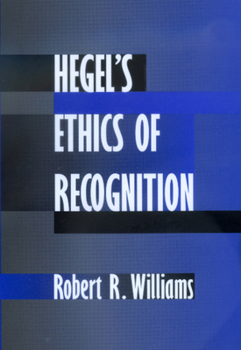
Hegel's Ethics of Recognition
No Customer Reviews

Select Format
Select Condition 
Book Overview
In this significant contribution to Hegel scholarship, Robert Williams develops the most comprehensive account to date of Hegel's concept of recognition ( Anerkennung ). Fichte introduced the concept of recognition as a presupposition of both Rousseau's social contract and Kant's ethics. Williams shows that Hegel appropriated the concept of recognition as the general pattern of his concept of ethical life, breaking with natural law theory yet incorporating the Aristotelian view that rights and virtues are possible only within a certain kind of community. He explores Hegel's intersubjective concept of spirit ( Geist ) as the product of affirmative mutual recognition and his conception of recognition as the right to have rights. Examining Hegel's Jena manuscripts, his Philosophy of Right , the Phenomenology of Spirit , and other works, Williams shows how the concept of recognition shapes and illumines Hegel's understandings of crime and punishment, morality, the family, the state, sovereignty, international relations, and war. A concluding chapter on the reception and reworking of the concept of recognition by contemporary thinkers including Derrida, Levinas, and Deleuze demonstrates Hegel's continuing centrality to the philosophical concerns of our age.
Format:Paperback
Language:English
ISBN:0520224922
ISBN13:9780520224926
Release Date:October 2000
Publisher:University of California Press
Length:450 Pages
Weight:1.20 lbs.
Dimensions:1.1" x 6.0" x 9.1"
Customer Reviews
0 rating
Copyright © 2026 Thriftbooks.com Terms of Use
| Privacy Policy | Do Not
Sell/Share My Personal Information | Cookie Policy | Cookie Preferences | Accessibility Statement
ThriftBooks® and the ThriftBooks® logo are registered trademarks of Thrift Books Global, LLC
ThriftBooks® and the ThriftBooks® logo are registered trademarks of Thrift Books Global, LLC
