
Skip to content
Scan a barcode
Scan
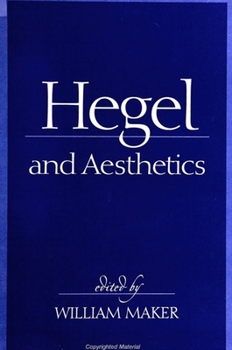
Paperback Hegel and Aesthetics Book

ISBN: 0791445526

ISBN13: 9780791445525

Hegel and Aesthetics

Select Format

Select Condition ThriftBooks Help Icon

Recommended

Format: Paperback

Temporarily Unavailable

We receive fewer than 1 copy every 6 months.

Save to List

Book Overview

Leading scholars consider Hegel's philosophy of art and its contemporary significance.

Hegel's Lectures on Aesthetics present a systematic and historical overview of the nature and development of art in light of its meaning and philosophical significance. This book considers Hegel's aesthetics from a variety of perspectives. With a strong and clear introduction by William Maker, the individual essays address Hegel's treatment of music, painting, comedy, and architecture, as well as his earlier writings on art, his relations to Schiller and to Schlegel, his treatment of romanticism, the place of aesthetics in the system, and his controversial claims about the overcoming of art. Several perspectives focus specifically on the contemporary relevance of Hegel's aesthetics in light of developments in art since his time, and especially in connection with modernism, postmodernism, and deconstruction.

Contributors include William Desmond, Brian K. Etter, Andrew G. Fiala, Martin Gammon, Edward Halper, Stephen Houlgate, David Kolb, Stephen C. Law, Judith Norman, Carl Rapp, Jere Surber, and Richard D. Winfield.

Related Subjects

Philosophy

Customer Reviews

1 rating

Hegel sees art as cultural phenomena that has deep significance for understanding reality

I read this book for a graduate seminar on the philosophy of art. "Introductory Lectures of Aesthetics" is a great way to learn about G. W. F. Hegel's ideas on how art, religion, and philosophy interact and should not be seen as sharp divisions of thought. It is important to note that the Germans look on art as more than art. They look on art as cultural phenomena that has deep significance for understanding reality and not just to study experiences and such. Hegel is reacting to the modern model of aesthetics and the expression theory of Kant. Hegel looks on art as a fundamental development of the "spirit" spirit meaning thought culture and so on. Hegel had this relation between art, religion, and philosophy by religion he means a more developed religion that has more of an element of thought in it and how it talks about the nature of the world and the creation and purpose of the world. However, art in terms of poetry and the visual arts Hegel thinks is the first form that spirit takes as a sensuous form. The idea of a sensuous medium seems to be a necessary condition, in that art is fashioned in its own kind of material into a product that communicates something. Hegel says forms of art in history come before developed systems like religion and philosophy. By that, he means the human spirit is evolving and that the first forms indicate the representing of ideas and spiritual notions of sensuous forms. He does not at all hold to the idea that art is simply the expressions of subjective faculties. Hegel thinks of art as a manifestation of elements of reality, but in an early form. This is Hegel's developmental theory that spirit progresses. Organized religion expands to getting into philosophy that gets much closer to the truth by being more conceptual and theoretical. The important influence Hegel had is on the overall theory of Greek tragedy as an avenue to thought and not just tragedy. For example, throughout my years of studying the play "Antigone," I have been impressed by learning the fact that between Aristotle and Freud critics, philosophers and scholars have written so much about the play. There can be no doubt this is due to the fact as I have discovered "Antigone" was so successful at providing a lens for one to "see," and thus understand the essence of human life with all its tragic pitfalls. In particular, Hegel spent a considerable amount of time gleaning lessons from "Antigone" that have helped me to use it as a lens to "see" more clearly how humans have to question and ultimately choose between competing moral choices. According to Hegel's account of Greek tragedy, Hegel did not view Greek tragedy as a collision between good and evil, but between competing goods. In addition, Hegel proposes in his interpretation of Greek tragedy, that the sufferings of the tragic hero are merely the means of reconciling the opposing moral goods--between two entirely ethical worlds that clash and cannot come together. Both
Copyright © 2026 Thriftbooks.com Terms of Use | Privacy Policy | Do Not Sell/Share My Personal Information | Cookie Policy | Cookie Preferences | Accessibility Statement
ThriftBooks ® and the ThriftBooks ® logo are registered trademarks of Thrift Books Global, LLC

GoDaddy Verified and Secured