


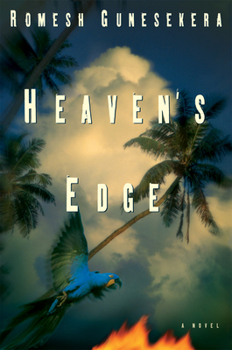
Heaven's Edge

Select Format
Select Condition 
Book Overview
I. NUBURN Marc arrives from London at the Palm Beach hotel, on an island that is never named but is presumably based on the author's native Sri Lanka. He is disappointed to see that poverty has made accommodations scarce and the starved attendants are surly and disdainful. He doesn't like to think of himself as a tourist, but rather a man on a spiritual mission: his grandfather Eldon, a flying instructor, was born on the island but left it when war broke out and challenged his pacifism. The grandfather expatriated to London, where he met a Caribbean ex-patriate and made a family with her, occupying himself with his love of gardening. Eventually Eldon took his son Lee back to the island to show off its natural splendors, and the home that had been destroyed. While Eldon remained happy to be gone from the culture of relentless violence and oppression that emerged there when rival colonialists withdrew and left the island to endlessly feuding warlords, his son Lee, Marc's father, was enchanted by his father's descriptions of their homeland, and to the shame of his father eventually returned there to fight as a helicopter pilot, intending to bring his son (Marc) and wife there once it was safe. He was killed in action. After discovering a videotape in which his late father showed off the island's beauty, Marc found himself drawn to it, and so it is that he ends up on an island he knows very little about. Marc tries to explore the island but is discouraged by numerous military cordons and rules preventing tourists from entering the war-torn villages. "The sense of subjugation was something I had not expected on an island infused with myth and mystery. This was a place, it seemed to me then, devoid of any joy past, present or future." Finally he wanders toward the outer ramparts of the village, and then into jungle bush, where he spots a woman who is releasing two doves. Immediately he is enchanted by her, but when he tries to converse with her, she is disdainful of the fact that he is a tourist. Eventually she disappears, leaving him to think about her all the next day, when he returns to the same spot and finds her there. He discovers that she is a "secret farmer," cultivating birds and vegetation in a secret location in order to restore the natural riches that war has stripped away. (Uva's mother "wanted these to return to a richer jungle rather than the leached scrubland that retreating global markets and distitute governments left in their wake.") In spite of having little in common-he is na ve and optimistic, while she became practical and cynical after her parents were killed by soldiers-Marc and Uva fall in love, and when Marc tells her of the paradise his grandfather often talked about, she describes a place in the south "full of butterflies and flowers," Samandia. But no one ever goes there anymore-Marc will have to "find your own Eden." Marc's innocence ends when a hotel worker he has made friends with, Nirali, is executed. Uva observes: "The sand here never stains, you know, no matter how much blood is spilled... War here, like everywhere else, was once about land and identity. But after death cloud in the south everything changed. You see we were reshaped by gangsters into new collectives held together only by conscription. Not language, not religion, not any of those outmoded notions of nation. After so many years of fighting, violence became ingrained into our way of life. So now we have only thugs for politicians and tyranny in every tribe. Killers everywhere." Indeed, eventually one of these tribes discovers and burns down Uva's secret farm and goes after her. Mercenaries storm the hotel and Uva and Marc are separated when Marc is shot with a tranquilizer dart. II. MARAVIL Marc wakes up in a prison compound, tagged in the ear in case he escapes. The prisoners get a chance to go to Maravil, a shelled-out town where he remembers Uva mentioned having a friend nam
Format:Paperback
Language:English
ISBN:0802141455
ISBN13:9780802141453
Release Date:July 2004
Publisher:Grove Press
Length:256 Pages
Weight:0.70 lbs.
Dimensions:0.7" x 5.5" x 8.3"
Customer Reviews
2 ratings
"There is no tomorrow without yesterday."
Published by Thriftbooks.com User , 20 years ago
Heaven's Edge is unique--it is not a romance, not a war chronicle, not a religious allegory, not a plea for ecological responsibility, and not science fiction, though it contains elements of all these genre. Marc, a young college graduate from London, has returned to an unnamed island, much like the author's island of Sri Lanka, on a mission to connect with his father's memory. His father, a military pilot, left the family in England when Marc was a very young child and returned to the island where he died while on a mission. Marc's doting grandfather, who raised him, never understood what drove his son to return to the very island he himself had escaped. The novel opens with Marc's arrival at the island by boat, and Gunesekera quickly establishes the mood and the themes of freedom and repression, and past and present, as the boatman, upon his arrival, releases two flying fish, accidentally netted during the trip. The island is under military control, and the hotel where Marc stays strictly limits his movements. In an intensely romantic scene, Marc escapes the stultifying restrictions one day and meets Uva, a young woman who is trying to repopulate the forest with native birds and animals, all of which have disappeared during the long war. When Marc is suddenly rendered unconscious and Uva disappears from his life, the mood changes instantly from romance to surreality, as Marc finds himself in captivity, enduring a regimented life more akin to science fiction than the heights of romance. Mind-numbing violence, brutally perpetrated by the military to remove any question of free thought and independent activity in the population, is the only constant in the lives of the characters, as Gunesekera explores our need to remain connected to our pasts and the ways in which our futures are outgrowths of our pasts. The graphically described violence further sets into sharp relief themes of personal identity, the desire for beauty, and the need to protect and preserve the natural world. Sometimes enigmatic and even a bit preachy, the novel is at once magical and nightmarish, full of myth and allegory at the same time that it offers haunting, cautionary tales about the past and the use of violence to change the present and affect the future. Echoes of Adam and Eve and the Garden of Eden, the fall of man, legends about peacocks and leopards, and episodes telling the importance of love and respect pervade the novel, giving it immense color and depth. Clearly a pacifist, Gunesekera says, "The art of killing cannot be our finest achievement...Nothing is inevitable." But Gunesekera does not believe in being completely passive or non-violent when faced with true threats to life. "Sometimes you have to sacrifice your innocence to protect this world," he says. In this memorable novel with its stunning depictions of nature, especially birds and butterflies as they try to survive the depredations of man, he makes a powerful, ecological and political statement,
"There is no tomorrow without yesterday."
Published by Thriftbooks.com User , 22 years ago
Heaven's Edge is unique--it is not a romance, not a war chronicle, not a religious allegory, not a plea for ecological responsibility, and not science fiction, though it contains elements of all these genre. Marc, a young college graduate from London, has returned to an unnamed island, much like the author's island of Sri Lanka, on a mission to connect with his father's memory. His father, a military pilot, left the family in England when Marc was a very young child and returned to the island where he died while on a mission. Marc's doting grandfather, who raised him, never understood what drove his son to return to the very island he himself had escaped. The novel opens with Marc's arrival at the island by boat, and Gunesekera quickly establishes the mood and the themes of freedom and repression, and past and present, as the boatman, upon his arrival, releases two flying fish, accidentally netted during the trip. The island is under military control, and the hotel where Marc stays strictly limits his movements. In an intensely romantic scene, Marc escapes the stultifying restrictions one day and meets Uva, a young woman who is trying to repopulate the forest with native birds and animals, all of which have disappeared during the long war. When Marc is suddenly rendered unconscious and Uva disappears from his life, the mood changes instantly from romance to surreality, as Marc finds himself in captivity, enduring a regimented life more akin to science fiction than the heights of romance. Mind-numbing violence, brutally perpetrated by the military to remove any question of free thought and independent activity in the population, is the only constant in the lives of the characters, as Gunesekera explores our need to remain connected to our pasts and the ways in which our futures are outgrowths of our pasts. The graphically described violence further sets into sharp relief themes of personal identity, the desire for beauty, and the need to protect and preserve the natural world. Sometimes enigmatic and even a bit preachy, the novel is at once magical and nightmarish, full of myth and allegory at the same time that it offers haunting, cautionary tales about the past and the use of violence to change the present and affect the future. Echoes of Adam and Eve and the Garden of Eden, the fall of man, legends about peacocks and leopards, and episodes telling the importance of love and respect pervade the novel, giving it immense color and depth as Marc tries to connect with the past. Clearly a pacifist, Gunesekera says, "The art of killing cannot be our finest achievement...Nothing is inevitable." But Gunesekera does not believe in being completely passive or non-violent when faced with true threats to life. "Sometimes you have to sacrifice your innocence to protect this world," he says. In this memorable novel with its stunning depictions of nature, especially birds and butterflies as they try to survive the depredations of man, he mak
Copyright © 2026 Thriftbooks.com Terms of Use
| Privacy Policy | Do Not
Sell/Share My Personal Information | Cookie Policy | Cookie Preferences | Accessibility Statement
ThriftBooks® and the ThriftBooks® logo are registered trademarks of Thrift Books Global, LLC
ThriftBooks® and the ThriftBooks® logo are registered trademarks of Thrift Books Global, LLC
