


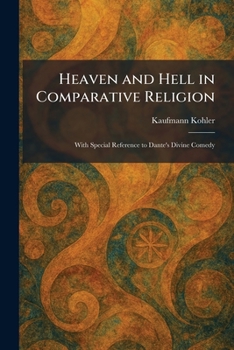
Heaven and Hell in Comparative Religion: With Special Reference to Dante's Divine Comedy

"Heaven and Hell in Comparative Religion: With Special Reference to Dante's Divine Comedy" is a profound scholarly exploration into the historical and theological development of the afterlife. Written by the esteemed theologian Kaufmann Kohler, this work provides a comprehensive analysis of how various world religions and ancient civilizations have conceptualized the soul's journey after death. By examining the eschatological beliefs of the Babylonians, Egyptians, Persians, and the Abrahamic faiths, Kohler traces the evolution of human thought regarding divine justice, punishment, and reward.
A significant portion of the study is dedicated to "Divine Comedy", using Dante Alighieri's masterpiece as a focal point to illustrate how these diverse religious traditions culminated in the vivid imagery of the Middle Ages. Kohler explores the philosophical and mythological roots that Dante drew upon to construct his vision of the Inferno, Purgatorio, and Paradiso. This volume serves as an essential resource for those interested in comparative religion, medieval literature, and the history of ideas, offering a bridge between classical theological doctrine and its most famous literary expression.
This work has been selected by scholars as being culturally important, and is part of the knowledge base of civilization as we know it. This work was reproduced from the original artifact, and remains as true to the original work as possible. Therefore, you may see the original copyright references, library stamps (as most of these works have been housed in our most important libraries around the world), and other notations in the work.
This work is in the public domain in the United States of America, and possibly other nations. Within the United States, you may freely copy and distribute this work, as no entity (individual or corporate) has a copyright on the body of the work.
As a reproduction of a historical artifact, this work may contain missing or blurred pages, poor pictures, errant marks, etc. Scholars believe, and we concur, that this work is important enough to be preserved, reproduced, and made generally available to the public. We appreciate your support of the preservation process, and thank you for being an important part of keeping this knowledge alive and relevant.
Customer Reviews
ThriftBooks ® and the ThriftBooks ® logo are registered trademarks of Thrift Books Global, LLC
