


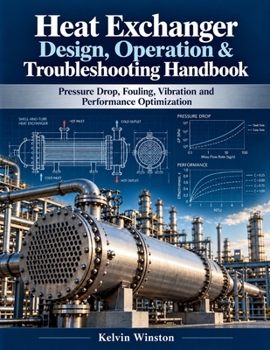
Heat Exchanger Design, Operation & Troubleshooting Handbook: Pressure Drop, Fouling, Vibration and Performance Optimization

A heat exchanger can meet its calculated area and still perform poorly in service.
Excessive pressure drop, fouling, vibration, leakage, flow maldistribution, changing process conditions, unsuitable materials, or incorrect assumptions can prevent equipment from delivering the required duty. Solving the problem requires more than another isolated calculation.
Heat Exchanger Design, Operation & Troubleshooting Handbook provides a practical engineering framework for connecting thermal calculations with hydraulic behavior, mechanical configuration, operating data, reliability, inspection, and maintenance.
The book begins with service definition and exchanger selection before developing the calculations behind energy balances, LMTD, effectiveness-NTU methods, overall heat-transfer coefficients, resistance networks, fluid properties, and pressure loss.
From there, the focus moves from equations to real equipment.
Readers will learn how to:
Select suitable exchanger families for different services.Evaluate shell-and-tube configurations, tube layouts, baffles, passes, and flow arrangements.Work with plate, spiral, hairpin, compact, and air-cooled exchangers.Analyze condensers, reboilers, evaporators, and phase-change applications.Connect thermal duty with velocity, pressure drop, fouling allowance, and pumping cost.Evaluate materials, wall temperature, thermal expansion, gaskets, supports, and nozzles.Recognize vibration risks and flow-induced damage mechanisms.Establish commissioning and operating baselines.Interpret changes in UA, temperatures, flow rates, and pressure drop.Distinguish fouling from instrumentation errors, bypassing, restriction, leakage, and physical damage.Plan cleaning, inspection, repair, and post-maintenance verification.Review vendor proposals, existing ratings, replacements, and debottlenecking studies more critically.Worked calculations, practice problems, explained answers, diagnostic cases, and decision sequences help connect theory to engineering practice.
The operating chapters show how plant data can be reconciled before conclusions are drawn. Instead of assuming every loss of performance is fouling, readers learn to examine the evidence systematically and determine whether the problem originates in the process, flow path, heat-transfer surface, instrumentation, controls, or mechanical condition.
Written for process engineers, mechanical engineers, operators, inspectors, maintenance personnel, and reliability professionals, this handbook works both as a structured learning resource and as a practical desk reference.
Whether you are evaluating a new design, checking an existing rating, investigating recurring loss of duty, planning maintenance, or reviewing a replacement exchanger, this book provides a disciplined way to move from symptoms to defensible engineering decisions.
Understand the thermal duty, verify the hydraulic behavior, identify the evidence, and make better heat-exchanger decisions from design through long-term operation.
Customer Reviews
ThriftBooks ® and the ThriftBooks ® logo are registered trademarks of Thrift Books Global, LLC
