


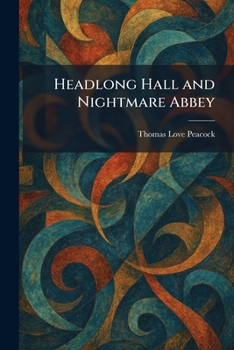
Headlong Hall and Nightmare Abbey

"Headlong Hall and Nightmare Abbey" brings together two of Thomas Love Peacock's most celebrated satirical works, offering a sharp-witted exploration of the intellectual and social trends of the early nineteenth century. Known for his unique "conversation novel" style, Peacock gathers eccentric characters in country house settings to engage in high-spirited debates over philosophy, science, and the arts.
In "Headlong Hall", the author skewers the optimism of the Enlightenment and the various "isms" of his day through a series of comedic dialogues between houseguests with diametrically opposed views on human progress. "Nightmare Abbey" shifts the focus to a brilliant parody of the Romantic movement and the Gothic tradition. With characters modeled after figures like Lord Byron and Percy Bysshe Shelley, the narrative pokes fun at the melancholy and morbid fascinations of contemporary poets and thinkers.
Rich in irony and intellectual playfulness, these novels remain essential examples of English satire. Peacock's masterful command of language and his ability to transform abstract ideas into comedic drama make this collection a delightful read for those interested in the history of ideas and the evolution of the comic novel.
This work has been selected by scholars as being culturally important, and is part of the knowledge base of civilization as we know it. This work was reproduced from the original artifact, and remains as true to the original work as possible. Therefore, you may see the original copyright references, library stamps (as most of these works have been housed in our most important libraries around the world), and other notations in the work.
This work is in the public domain in the United States of America, and possibly other nations. Within the United States, you may freely copy and distribute this work, as no entity (individual or corporate) has a copyright on the body of the work.
As a reproduction of a historical artifact, this work may contain missing or blurred pages, poor pictures, errant marks, etc. Scholars believe, and we concur, that this work is important enough to be preserved, reproduced, and made generally available to the public. We appreciate your support of the preservation process, and thank you for being an important part of keeping this knowledge alive and relevant.
Customer Reviews
ThriftBooks ® and the ThriftBooks ® logo are registered trademarks of Thrift Books Global, LLC
