


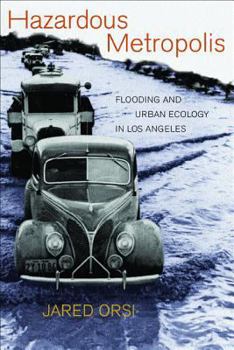
Hazardous Metropolis: Flooding and Urban Ecology in Los Angeles


Although better known for its sunny skies, Los Angeles suffers devastating flooding. This book explores a fascinating and little-known chapter in the city's history-the spectacular failures to control floods that occurred throughout the twentieth century. Despite the city's 114 debris dams, 5 flood control basins, and nearly 500 miles of paved river channels, Southern Californians have discovered that technologically engineered solutions to flooding are just as disaster-prone as natural waterways. Jared Orsi's lively history unravels the strange and often hazardous ways that engineering, politics, and nature have come together in Los Angeles to determine the flow of water. He advances a new paradigm-the urban ecosystem-for understanding the city's complex and unpredictable waterways and other issues that are sure to play a large role in future planning.
As he traces the flow of water from sky to sea, Orsi brings together many disparate and intriguing pieces of the story, including local and national politics, the little-known San Gabriel Dam fiasco, the phenomenal growth of Los Angeles, and, finally, the influence of environmentalism. Orsi provocatively widens his vision toward other cities for which Los Angeles may offer a lesson-both of things gone wrong and a glimpse of how they might be improved.
As he traces the flow of water from sky to sea, Orsi brings together many disparate and intriguing pieces of the story, including local and national politics, the little-known San Gabriel Dam fiasco, the phenomenal growth of Los Angeles, and, finally, the influence of environmentalism. Orsi provocatively widens his vision toward other cities for which Los Angeles may offer a lesson-both of things gone wrong and a glimpse of how they might be improved.
Format:Hardcover
Language:English
ISBN:0520238508
ISBN13:9780520238503
Release Date:January 2004
Publisher:University of California Press
Length:316 Pages
Weight:1.35 lbs.
Dimensions:1.1" x 6.4" x 9.2"
Customer Reviews
1 rating
New ways needed to control flooding in Southern California
Published by Thriftbooks.com User , 17 years ago
Review of _Hazardous Metropolis_ by Jared Orsi Southern California has always had a problem with either too little or too much water. Orsi's _Hazardous Metropolis_ is a history of how the region has coped with the latter problem. The Los Angeles River has always been very susceptible to flooding and changing its course. Initially, when the population of Los Angeles occupied only a relatively small area, this didn't matter much. But as LA grew and spread out along the waterways and into the areas near the mountains, floods caused serious damage and occasional widespread destruction. At first, flood control officials tried various technological solutions such as dams, flood control channels, and debris basins, with varying results. Sometimes, these strategies worsened the problem. After a particularly bad flood in 1938, the county, with the help of the Army Corps of Engineers, paved the channels of Los Angeles River and other waterways with concrete. For the most part, paving the channels seemed to work. So far, Southern California has not had the devastating flooding of the 1930's and before, although during two particularly strong storms, one in 1978 and another in 1980, the Los Angeles River came dangerously close to overflowing. However, not everyone was satisfied with the proposed flood control plan. A dam at Whittier Narrows would have required much of the City of El Monte to be flooded. The citizens and leaders of El Monte, after a great deal of political haggling, managed to get the proposed dam moved to another location. The issue of El Monte was an important turning point in the history of the flood control plan, as it was the first time that public opinion had any effect on it. In the mid-1960's, environmental concerns about the flood control plan started to come to light. The City of Sierra Madre wanted the stream that flowed through it to look natural, not encased in concrete. And later, in the 1990's, activist groups pushed for a "regreening" of the concrete-lined Los Angeles River. The people living near the river were, however, less interested in returning it to its natural state and more interested in the its recreational potential, such as using the surrounding land for parks and playgrounds. The last chapter in the book, "Historical Structure of Disorder", explains that natural events, such as floods, cannot always be perfectly predicted or managed by human actions. It is necessary to take into account the opinions of not only the engineers, but also those of the environmental organizations, community groups, and others who might be affected by any changes made in the flood control system _Hazardous Metropolis_ covers the history and future of flood control in Southern California in an easy-to-understand manner. It is neither overly technical nor politically biased. Again he emphasizes having everyone involved in the flood control system listen to each other and work together This book can be compared with Blake Gumprec
Copyright © 2026 Thriftbooks.com Terms of Use
| Privacy Policy | Do Not
Sell/Share My Personal Information | Cookie Policy | Cookie Preferences | Accessibility Statement
ThriftBooks® and the ThriftBooks® logo are registered trademarks of Thrift Books Global, LLC
ThriftBooks® and the ThriftBooks® logo are registered trademarks of Thrift Books Global, LLC
