


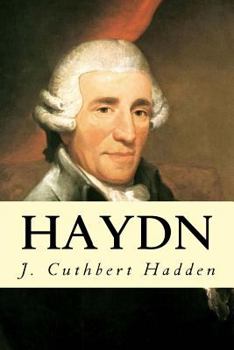
Haydn
No Customer Reviews

Select Format
Select Condition 
Book Overview
Haydn, by J. Cuthbert Hadden, is a classical music biography about the great Austrian composer, Joseph Haydn. The authority for Haydn's life is the biography begun by the late Dr Pohl, and completed after his death by E.V. Mandyczewski. To this work, as yet untranslated, every subsequent writer is necessarily indebted, and the present volume, which I may fairly claim to be the fullest life of Haydn that has so far appeared in English, is largely based upon Pohl. -J. Cuthbert Hadden (Franz) Joseph Haydn 31 March 1732 - 31 May 1809) was an Austrian composer of the Classical period. He was instrumental in the development of chamber music such as the piano trio 2] and his contributions to musical form have earned him the epithets "Father of the Symphony" and "Father of the String Quartet". Haydn spent much of his career as a court musician for the wealthy Esterh zy family at their remote estate. Until the later part of his life, this isolated him from other composers and trends in music so that he was, as he put it, "forced to become original". Yet his music circulated widely, and for much of his career he was the most celebrated composer in Europe. He was a friend and mentor of Mozart, a teacher of Beethoven, and the older brother of composer Michael Haydn. Joseph Haydn was born in Rohrau, Austria, a village that at that time stood on the border with Hungary. His father was Mathias Haydn, a wheelwright who also served as "Marktrichter", an office akin to village mayor. Haydn's mother Maria, n e Koller, had previously worked as a cook in the palace of Count Harrach, the presiding aristocrat of Rohrau. Neither parent could read music; n 4] however, Mathias was an enthusiastic folk musician, who during the journeyman period of his career had taught himself to play the harp. According to Haydn's later reminiscences, his childhood family was extremely musical, and frequently sang together and with their neighbours. Haydn's parents had noticed that their son was musically gifted and knew that in Rohrau he would have no chance to obtain serious musical training. It was for this reason that, around the time Haydn turned six, they accepted a proposal from their relative Johann Matthias Frankh, the schoolmaster and choirmaster in Hainburg, that Haydn be apprenticed to Frankh in his home to train as a musician. Haydn therefore went off with Frankh to Hainburg 12 kilometres (7.5 mi) away; he never again lived with his parents. Life in the Frankh household was not easy for Haydn, who later remembered being frequently hungry 5] and humiliated by the filthy state of his clothing. 6] He began his musical training there, and could soon play both harpsichord and violin. The people of Hainburg heard him sing treble parts in the church choir. There is reason to think that Haydn's singing impressed those who heard him, because in 1739 n 5] he was brought to the attention of Georg von Reutter, the director of music in St. Stephen's Cathedral in Vienna, who happened to be visiting Hainburg and was looking for new choirboys. Haydn passed his audition with Reutter, and after several months of further training moved to Vienna (1740), where he worked for the next nine years as a chorister.
Format:Paperback
Language:English
ISBN:1500889350
ISBN13:9781500889357
Release Date:August 2014
Publisher:Createspace Independent Publishing Platform
Length:186 Pages
Weight:0.56 lbs.
Dimensions:0.4" x 6.0" x 9.0"
Customer Reviews
0 rating
Copyright © 2026 Thriftbooks.com
Terms of Use | Privacy Policy | Do Not Sell/Share My Personal Information | Cookie Policy | Cookie Preferences | Accessibility Statement
ThriftBooks ® and the ThriftBooks ® logo are registered trademarks of Thrift Books Global, LLC
ThriftBooks ® and the ThriftBooks ® logo are registered trademarks of Thrift Books Global, LLC
