


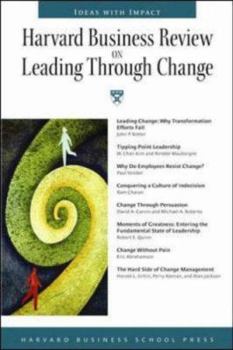
Harvard Business Review on Leading Through Change (Harvard Business Review Paperback Series)

From the preeminent thinkers whose work has defined an entire field to the rising stars who will redefine the way we think about business, 'The Harvard Business Review Paperback Series' delivers the fundamental information today's professionals need to stay competitive in a fast-moving world.
Format:Paperback
Language:English
ISBN:1422102807
ISBN13:9781422102800
Release Date:October 2006
Publisher:Harvard Business Press
Length:178 Pages
Weight:0.95 lbs.
Dimensions:8.0" x 0.5" x 5.3"
Customer Reviews
2 ratings
Why some change initiatives succeed...and others fail
Published by Thriftbooks.com User , 18 years ago
This is one in a series of several dozen volumes that comprise the "Harvard Business Review Paperback Series." Each offers direct, convenient, and inexpensive access to the best thinking on the given subject in articles originally published by the Harvard Business School Review. I strongly recommend all of the volumes in the series. The individual titles are listed at this Web site: www.hbsp.harvard.edu. The authors of various articles are among the world's most highly regarded experts on the given subject. Each volume has been carefully edited. Supplementary commentaries are also provided in most of the volumes, as is an "About the Contributors" section that usually includes suggestions of other sources that some readers may wish to explore. In this volume, the reader is provided with eight articles whose authors provide a variety of perspectives on how to lead an organization through a process of significant change while minimizing fear, frustration, and resistance. All of the articles first appeared in the HBR over an extended period of time, from March-April, 1992, to October, 2005; some but remarkably little of the material is dated. Here are some of the important business issues to which four contributors direct their (and our) attention: Which seem to be the most common mistakes made by executives? ("Leading Change: Why Transformation Efforts Fail," John P. Kotter) Comment: Kotter identifies eight and suggests how to avoid or repair them. How to focus only on what is most important? ("Tipping Point Leadership," W. Chan Kim and Renée Mauborgne) Comment: The co-authors of Blue Ocean Strategy explain how "tipping points" can result in fundamental changes when a sufficient number of people embrace and support a powerful idea. They examine how a newly appointed police commissioner, in less than two years, turned New York into the safest large city in the nation by following a four-step process to bring about rapid, dramatic, and lasting change with limited resources. Why is follow-through "the DNA of decisive cultures"? ("Conquering a Culture of Indecision," Ram Charan) Comment: In all of his various books and articles, Charan stresses the importance of making correct decision and then taking effective action to achieve desired results, whatever they may be. To change a culture of decision, he insists, leaders must ask hard questions such as "How robust and effective are our social operating mechanisms?" GE has forged a system of ten tightly linked operating mechanisms that, Charan suggests, comprise its "secret weapon." Why are leaders sometimes "on" and other times Not? (""Moments of Greatness: Entering the Fundamental State of Leadership," Robert E. Quinn) Comment: Quinn identifies four "awareness-raising questions" which leaders must ask and then answer honestly so that they can challenge themselves to have a positive impact on their own lives and on those around them. These questions "often lead to high-performance outcomes, an
Highly Recommended for Executives Leading Organizations Through Change
Published by Thriftbooks.com User , 19 years ago
I picked this book up at an airport to have something to read on my flight, and I was not disappointed in the least. It provides excellent information and insight on leading organizations during times of change. In Kotter's essay, "Leading Change: Why Transformation Efforts Fail", he analyzes common errors of leading through change, and converts them into 8 steps for transforming an organization: (1) establishing a sense of urgency, (2) forming a powerful guiding coalition, (3) creating a vision, (4) communicating the vision, (5) empowering others to act on the vision, (6) planning for and creating short-term wins, (7) consolidating improvements and creating still more changes, and (8) institutionalizing new approaches. Kotter shows how these 8 principles can lead to either the downfall or the success of an organization. I also found Ram Charan's essay, "Conquering a Culture of Indecision", to be extremely helpful. He outlines the steps for creating greater communication, turning that into action, and providing follow-through and feedback. Also of great interest to me was Eric Abrahamson's "Change Without Pain". He defines the difference between "tinkering" and "kludging" (tinkering with a college education). He also offers helpful operating guidelines that make quite a bit of sense. Different essays will be more relevant for different individuals, but all in all, this compilation of essays provides excellent insight, and should be required reading for executive teams in the midst of major periods of change.
Copyright © 2026 Thriftbooks.com
Terms of Use | Privacy Policy | Do Not Sell/Share My Personal Information | Cookie Policy | Cookie Preferences | Accessibility Statement
ThriftBooks ® and the ThriftBooks ® logo are registered trademarks of Thrift Books Global, LLC
ThriftBooks ® and the ThriftBooks ® logo are registered trademarks of Thrift Books Global, LLC
