


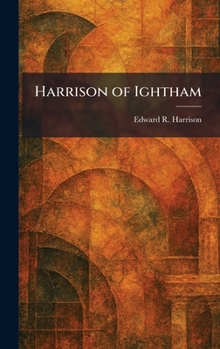
Harrison of Ightham

"Harrison of Ightham" is a compelling biographical account of the life and pioneering scientific contributions of Benjamin Harrison, the renowned amateur archaeologist and geologist from Kent. Written by his son, Sir Edward R. Harrison, this work explores the fascinating story of a man who, while balancing the duties of a village shopkeeper, became a central figure in the late Victorian debates regarding human antiquity.
The narrative details Harrison's tireless exploration of the North Downs, where his discovery of "eoliths"-primitive flint tools-challenged existing scientific paradigms and suggested a much earlier date for the presence of early humans in Britain than was previously accepted. The book captures his correspondence and collaborations with leading scientific minds of the era, illustrating the vital role played by dedicated amateurs in the advancement of prehistoric archaeology and geology.
Through personal letters, diaries, and records, "Harrison of Ightham" offers a vivid portrait of a man driven by intellectual curiosity and a deep connection to his local landscape. It serves as both an intimate family memoir and a significant historical document reflecting the evolution of archaeological thought in the early twentieth century. This work remains an essential resource for those interested in the history of science and the rugged beauty of the English countryside.
This work has been selected by scholars as being culturally important, and is part of the knowledge base of civilization as we know it. This work was reproduced from the original artifact, and remains as true to the original work as possible. Therefore, you may see the original copyright references, library stamps (as most of these works have been housed in our most important libraries around the world), and other notations in the work.
This work is in the public domain in the United States of America, and possibly other nations. Within the United States, you may freely copy and distribute this work, as no entity (individual or corporate) has a copyright on the body of the work.
As a reproduction of a historical artifact, this work may contain missing or blurred pages, poor pictures, errant marks, etc. Scholars believe, and we concur, that this work is important enough to be preserved, reproduced, and made generally available to the public. We appreciate your support of the preservation process, and thank you for being an important part of keeping this knowledge alive and relevant.
Customer Reviews
ThriftBooks ® and the ThriftBooks ® logo are registered trademarks of Thrift Books Global, LLC
