


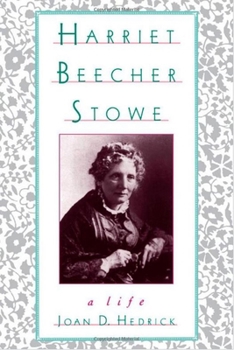
Harriet Beecher Stowe: A Life

Select Format
Select Condition 
Book Overview
Revised
Format:Paperback
Language:English
ISBN:0195096398
ISBN13:9780195096392
Release Date:August 1970
Publisher:Oxford University Press, Incorporated
Length:544 Pages
Weight:1.79 lbs.
Dimensions:1.3" x 5.9" x 9.1"
Customer Reviews
3 ratings
The little woman and the great book
Published by Thriftbooks.com User , 16 years ago
Joan Hedrick's biography of Harriet Beecher Stowe is first rate. It is masterful in the way it tells the story of a prolific author whose life spanned most of the 19th century (1811-1896). What is even better is the way Hedrick places Stowe within the contexts of some of the most dynamic strands of American history and literature in this period: religious perfectionism, the anti-slavery movement, the development of professional authors, women's suffrage, the consumerism of the Gilded Age, and the increase in influence of "high" culture, among others. And, of course, there is Stowe's membership in the wonderful extended Beecher family, including her father, the famous preacher and theologian; her sister Catherine, the educator; her half-sister Isabella, the suffragist; her preacher brother Henry Ward, the subject of a famous scandal. These individuals, along with the long-suffering (and occasionally jealous) Calvin Stowe, her husband, appear and disappear like comets on the pages of this book. One of the things I most enjoyed is Hedrick's discussion of how Stowe, one of the first women to make a living from her writing, ordered her life in order to make that writing possible. That she produced any work at all from the domestic disorders represented by seven children, scant income, frequent moves (related to Calvin's career as a theologian), and illness, not to mention political turmoil, is a miracle. This is a scholarly biography, unlikely to appeal to a reader who simply wants to learn a bit more about this compelling woman. However, if you have a particular interest in the period, Hedrick's biography will set you down right in the midst of the turmoil, domestic and historic, that characterized Harriet Beecher Stowe's life. There are, in addition, a well-chosen set of photographs, extensive endnotes, and a fine bibliography. M. Feldman
A Wonderful Biography, A Wonderful History
Published by Thriftbooks.com User , 21 years ago
I'm very glad that some of the negative reviews didn't put me off this book. It is not only a wonderful biography of the life of this great author, but it is an excellent history of so much of the 19th century. Mind you, it's not light, summertime reading. I liked to read a chapter a night, because there was so much to savor and think about. I learned a tremendous amount about life in that time, (how did any of our ancestors survive long enough to bring us into the world?), and about everything from the anti-slavery movement, to women's rights, to the religious fervor of the day. It provided a comprehensive look at the development of a nation and a national character. Of course, the centerpiece of it all is Mrs. Stowe, and she really came alive for me. The author makes good use of letters, so Mrs. Stowe, her family and friends can speak for themselves. And what a family it was! The famous Beecher clan in all its glory! Through the development of Mrs. Stowe's writing, we also see a change in how literature was viewed. From "Parlor Literature" which led to "Uncle Tom's Cabin" being read by all classes, it eventually became divided into high-class versus popular...what was critically acclaimed as opposed to what the people liked. It's a division that persists to this day, and led to Mrs. Stowe's masterpiece eventually being devalued as just melodramatic women's writing. I think this is a first-class biography and history. There's a reason why it won the Pulitzer Prize for biography. It will stand as the definitive biography of a great author and a great lady.
Highly recommend
Published by Thriftbooks.com User , 22 years ago
This is an excellent scholarly biography of Stowe, wonderfully researched and clearly written. Hedrick quotes generously from Stowe's letters, so the reader gets a feel for her voice and those of her family members. She puts Stowe's life in context beautifully, so besides being a great biography, it's also an excellent source on 19th-century millenialist, abolition, and suffrage movements and on the case of women writers & canon formation. Anyone who has read and liked Mary Kelly's Private Woman, Public Stage will like this book, too. My only complaint is that the end rushes in -- Hedrick covers something like 14 years in the last chapter. Granted much of this time Stowe seemed to be developing Alzheimer's, but I would have liked a bit more detail. What was she doing in her lucid periods? What was her feminist sister Isabella doing and how did Stowe's youngest ne'er-do-well son go from a ship's boy to a Harvard student? These are quibbles, though. In fact, one of the things I most like about this book is that Hedrick doesn't supply information when there isn't any to be found. There's very little speculation here, no inappropriately imagined scenes, no "Stowe must have thought" or "Stowe must have done." For Hedrick, either it happened or it didnt; she knows the difference between a biography and a novel.
Copyright © 2026 Thriftbooks.com
Terms of Use | Privacy Policy | Do Not Sell/Share My Personal Information | Cookie Policy | Cookie Preferences | Accessibility Statement
ThriftBooks ® and the ThriftBooks ® logo are registered trademarks of Thrift Books Global, LLC
ThriftBooks ® and the ThriftBooks ® logo are registered trademarks of Thrift Books Global, LLC
