


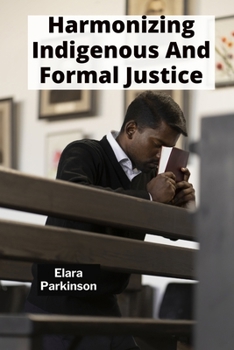
Harmonizing Indigenous And Formal Justice: Challenges Of Integration And Coexistence

In a world often defined by rigid structures and contrasting viewpoints, the quest for equitable justice remains a fundamental challenge.
Particularly when navigating the complex interplay between Indigenous and formal legal systems. Harmonizing Indigenous and Formal Justice: Challenges of Integration and Coexistence delves deep into this intricate terrain, offering a comprehensive exploration of the issues, the inherent conflicts, and the possibilities for a more unified future. This book isn't just an academic discourse; it's a critical examination of our societal norms and our responsibilities in the pursuit of genuine justice for all.
Moving from the theoretical to the practical, ""Integration Challenges: Case Studies"" presents tangible examples of the difficulties in harmonizing these two different systems. Each case study-ranging from disputes over land rights and environmental justice to conflicts within criminal justice, family law, and child welfare-is a stark reminder of the practical conflicts that arise from contrasting legal philosophies and deeply ingrained cultural perspectives. The diversity of cases demonstrates that integration isn't a monolithic challenge but a complex web of issues that require nuanced understanding and specific solutions. These case studies highlight the real human cost of failing to bridge these differences.
The book doesn't just dwell on challenges; it also offers solutions in the chapter ""Coexistence Models: Exploring Options."" This crucial section explores various possibilities for achieving a more harmonious relationship between these systems. From exploring the concept of parallel systems operating side-by-side to delving into integrated models with joint jurisdiction, and innovative hybrid approaches, this chapter examines the merits and pitfalls of each, giving readers a comprehensive overview of potential pathways forward. Each approach is evaluated through a critical lens, showing that there's no one-size-fits-all answer, and that effective solutions require collaboration and adaptability. This section emphasizes the need to move beyond adversarial relationships towards cooperative strategies.
And finally, the book culminates in the ""Conclusion: The Path Forward,"" a powerful call to action that encapsulates the central themes of the book. It summarizes the challenges, acknowledges the opportunities, and stresses the crucial need for bridge-building through collaboration, mutual understanding, and a shared commitment to a society that embodies genuine justice for all. The conclusion underscores that this is not a final destination but a continuous process of learning, adapting, and working together for a more equitable world. This isn't just the end of the book; it's the beginning of a critical conversation. This book isn't just about legal systems; it's about our shared future.
Harmonizing Indigenous and Formal Justice: Challenges of Integration and Coexistence is more than just a book; it's an essential resource for legal professionals, policymakers, activists, community leaders, and anyone committed to social justice. It's a must-read for understanding the complexities of justice systems in multicultural societies and the urgent need to reconcile our past with our present. This is your opportunity to become an agent of change.
Secure your wisdom now, let the knowledge empower your actions and illuminate your path to a better-balanced legal horizon.
Customer Reviews
ThriftBooks ® and the ThriftBooks ® logo are registered trademarks of Thrift Books Global, LLC
