


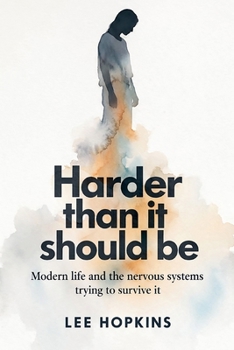
Harder Than It Should Be

You haven't lost your edge. Your cognitive infrastructure got demolished and nobody sent you the memo.
Since 2020, something has quietly shifted for millions of capable, educated, still-functioning adults. Thinking feels heavier. Attention scatters more easily. Tasks that once required forty minutes now take ninety. The doctor says you're fine. The blood work is normal. You do not feel normal.
Counselling psychologist Lee Hopkins explains why. Harder Than It Should Be reveals that post-2020 life simultaneously increased cognitive demand and dismantled the invisible supports, from environmental routines to bodily scaffolding to ambient social co-regulation, that had been carrying a significant portion of your thinking for decades. When that architecture disappeared, the workload didn't. It relocated inward. And nobody adjusted the budget.
Integrating cognitive neuroscience, chronic stress physiology, post-viral research, and the emerging science of neurodivergent amplification under strain, Hopkins identifies a convergence that no single discipline is naming: glutamate accumulation, allostatic overload, subclinical neuroinflammation, and the collapse of extended cognition all targeting the same prefrontal circuits. The result is population-level depletion that resilience culture consistently misreads as personal failure.
This is not a burnout book. This is not a collapse narrative. This is a recalibration book, one that validates what you've been experiencing, explains the converging forces behind it, and offers practical reorientation without fantasy, false optimism, or the suggestion that you simply need to try harder.
Written by a psychologist who was diagnosed AuDHD at sixty-six after decades of misdiagnosis, relocated from Adelaide to Vietnam, and watched the same brain start working again in a different environment, same pension, different scaffolding, Harder Than It Should Be is the book for everyone who keeps saying 'I used to be sharper' and deserves to know why.
For readers of Johann Hari, Oliver Burkeman, Emily Nagoski, and Bessel van der Kolk who haven't yet found the book that connects all the pieces.
From the back cover
'We did not return to normal. We adjusted to chronic strain and called it resilience.'
About the author
Lee Hopkins is an Australian counselling psychologist, writer, and entrepreneur based in Đ Lạt, Vietnam. He holds a Master's in Counselling Practice specialising in depression and bipolar disorder for veterans, has accumulated over 450 academic citations in organisational psychology, and served in the Royal Australian Air Force. After a decade as one of Australia's leading social media strategists, he retrained as a counsellor when he recognised the damage digital platforms were doing to mental health. Diagnosed AuDHD at sixty-six after decades of misdiagnosis as Bipolar II, he relocated to Vietnam, where the same brain that couldn't function in Adelaide began functioning again. He writes from the intersection of clinical literacy and lived scar tissue. His previous books include It's the Circumstances, Misdiagnosed, The Body Remembers the Fire, and Understanding AuDHD.
Related Subjects
PsychologyCustomer Reviews
ThriftBooks ® and the ThriftBooks ® logo are registered trademarks of Thrift Books Global, LLC
