


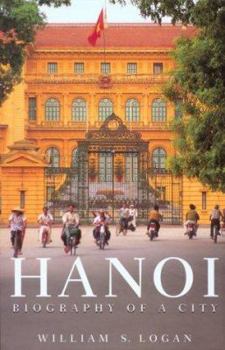
Hanoi: Biography of a City
No Customer Reviews

Select Format
Select Condition 
Book Overview
For more than a thousand years, Hanoi has been bending with the wind to resist foreign domination while absorbing foreign influences, first from China, then imperial France, then the Soviet Union, and now the go-go culture of globalization and rapid urban development. Like Venice, the city has been called a perfect marriage of land and water, but it teems with competing heritages--it is at once a museum of socialist monuments, a masterpiece of French colonial urbanism, and the home of ancient Buddhist temples with strong Taoist and Confucian influences.William Logan explores the many layers of Hanoi 's built environment, describing the history of ancient Thang Long as the political and religious center of the Red River basin, and its evolution into modern Hanoi . After 1873, the French brought gaslights, leafy wide avenues, modern sanitation systems, and vivacious new secular temples of Art Deco and International Style. The French also built notorious symbols of oppression such as Hoa Lo prison, where many revolutionaries were executed. Logan documents clandestine safe houses and other landmarks of subversive intrigues of the early Communist period. He also charts the rise of the Vietnamese middle class, the perennial pressures of population density in the Ancient Quarter, the destruction of the urban fabric and drastic population fluctuations during the wars with France and the United States, as well as the manipulation of heritage designations and distortion of national memory by succeeding political regimes.Rival nationalisms and modernisms of the 20th century come to life in streets and buildings triumphantly renamed after independence in 1954, but the proliferation of Soviet-style buildings was limited by material shortages and other disruptions during the "American War," though there was surprisingly little damage due to bombing. In the late 1980s, the Soviet models were discarded after economic liberalization, with an ironic result being the refurbishing of Hanoi 's colonial heritage to attract tourists.Finally, Logan pleads for international recognition of the swift erosion of cultural treasures in Hanoi , and the need for concerted efforts to preserve its distinctive visual character.
Format:Hardcover
Language:English
ISBN:0295980141
ISBN13:9780295980140
Release Date:January 2001
Publisher:Univ of Washington Pr
Length:304 Pages
Weight:1.85 lbs.
Dimensions:10.0" x 1.0" x 6.5"
Customer Reviews
0 rating
Copyright © 2026 Thriftbooks.com Terms of Use
| Privacy Policy | Do Not
Sell/Share My Personal Information | Cookie Policy | Cookie Preferences | Accessibility Statement
ThriftBooks® and the ThriftBooks® logo are registered trademarks of Thrift Books Global, LLC
ThriftBooks® and the ThriftBooks® logo are registered trademarks of Thrift Books Global, LLC
