


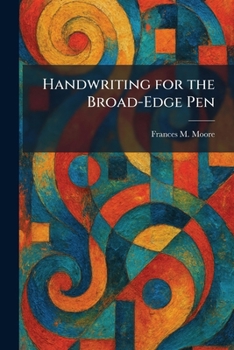
Handwriting for the Broad-Edge Pen

"Handwriting for the Broad-Edge Pen" is a definitive instructional guide focused on the art and technique of formal penmanship. Created by Frances M. Moore, this work serves as an essential manual for students and enthusiasts seeking to master the specific mechanics of the broad-edge pen. The text provides a systematic approach to letter formation, emphasizing the precision and elegance inherent in traditional calligraphic styles.
Through detailed lessons and structured exercises, the book explores the foundational principles of stroke construction, rhythm, and spacing. It addresses the practical application of the broad-edge pen in developing a legible and aesthetically pleasing hand, bridging the gap between everyday writing and decorative lettering. This manual is particularly noted for its clear demonstrations of how the angle and pressure of the pen influence the character of the script.
Ideal for calligraphers, artists, and educators, "Handwriting for the Broad-Edge Pen" remains a valuable resource for understanding the historical and technical underpinnings of formal handwriting. Its focus on clarity, discipline, and artistic expression makes it a timeless contribution to the study of the writing arts, offering readers a thorough grounding in a craft that combines utility with beauty.
This work has been selected by scholars as being culturally important, and is part of the knowledge base of civilization as we know it. This work was reproduced from the original artifact, and remains as true to the original work as possible. Therefore, you may see the original copyright references, library stamps (as most of these works have been housed in our most important libraries around the world), and other notations in the work.
This work is in the public domain in the United States of America, and possibly other nations. Within the United States, you may freely copy and distribute this work, as no entity (individual or corporate) has a copyright on the body of the work.
As a reproduction of a historical artifact, this work may contain missing or blurred pages, poor pictures, errant marks, etc. Scholars believe, and we concur, that this work is important enough to be preserved, reproduced, and made generally available to the public. We appreciate your support of the preservation process, and thank you for being an important part of keeping this knowledge alive and relevant.
Customer Reviews
ThriftBooks ® and the ThriftBooks ® logo are registered trademarks of Thrift Books Global, LLC
