


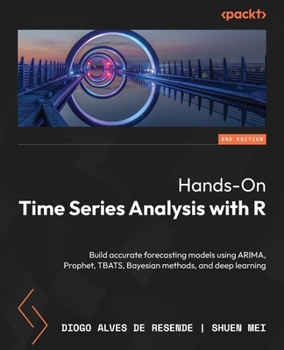
Hands-On Time Series Analysis with R - Second Edition: Build accurate forecasting models using ARIMA, Prophet, TBATS, Bayesian methods, and deep learn

Master modern time series forecasting in R using real datasets, applied models like ARIMA and Prophet, and advanced tools like LSTM for business-ready analysis
Key Features:
- Build a practical skills in time series forecasting using R from scratch
- Levereage traditional and deep learning models including ARIMA, Prophet, and LSTM
- Analyze and visualize real-world datasets to drive decisions and discover insights
- Purchase of the print or Kindle book includes a free PDF eBook
Book Description:
Hands-on Time Series Analysis with R, Second Edition, is a comprehensive, practical guide to understanding and applying time series analysis using R. Designed for professionals and students alike, the book will help you dissect time-ordered data, uncover trends, detect anomalies, and forecast future events.
You'll start with R fundamentals and data structures, progressing through time series visualization and decomposition, before covering classical forecasting methods like exponential smoothing and ARIMA. You'll also familiarize yourself with cutting-edge forecasting techniques such as Bayesian modeling, TBATS, and multivariate forecasting.
Building upon the extraordinary success of the first edition, this new edition explores the powerful Prophet library, neural networks, and LSTM models to handle complex forecasting challenges. Unlike other similar books, it uses real-world case studies from domains like e-commerce and supply chain make the content highly applicable, while self-assessment questions and step-by-step tutorials reinforce key concepts.
By the end of this book, you'll be able to confidently apply a wide array of forecasting methods to solve real-world business and research problems.
What You Will Learn:
- Work with time series data to uncover underlying patterns and trends
- Implement forecasting models like ARIMA and Prophet to predict future values
- Create powerful data visualizations to communicate time series insights
- Leverage R for time-based analysis across various domains
- Build and fine-tune models for different data scenarios
- Detect anomalies and adjust models for improved accuracy
- Use deep learning techniques like LSTM for complex time series tasks
Who this book is for:
This book is for junior to mid-level professionals in business intelligence, finance, and supply chain roles, as well as academics and students interested in data science. No prior expertise in time series analysis is required, but a working knowledge of basic R programming is helpful.
Table of Contents
- Getting Started with the Basics of R
- Understanding Time Series Data
- Working with Dates and Times
- Visualizing Time Series Data
- Exploratory Data Analysis for Time Series
- Exponential Smoothing and Holt-Winters
- The ARIMA Model Family
- Forecasting with TBATS Modeling
- Bayesian Approaches in Time Series Analysis
- Multi-Series Forecasting Techniques
- Prophet for Time Series
- Introducing Neural Networks for Time Series
- Deep Learning with LSTM Models
Customer Reviews
ThriftBooks ® and the ThriftBooks ® logo are registered trademarks of Thrift Books Global, LLC
