


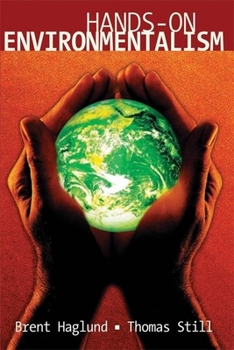
Hands on Environmentalism

Select Format
Select Condition 
Book Overview
The political environmentalism of the past 35 years was born of necessity: business as usual was not protecting the air, water and land. Brent Haglund and Thomas Still believe that the regulatory actions of the 1960s and 1970s were essential medicine for a careless society. But over time, the cure became something of a disease itself, a command-and-control system that widened the gulf between people and the natural world they live in. Writing for those who want to move past the environmental nanny state and reach the next level of stewardship, Haglund and Still describe a civic environmentalism based on local control, personal responsibility, government accountability and economic opportunity. They offer success stories demonstrating that civic environmentalism works. In Louisiana, private landowners formed the Black Bear Conservation Committee to restore the black bear from near extinction while avoiding an endangered species designation that would have constricted property rights. In Arizona, the White Mountain Apache tribe uses income from hunting licenses to fund an innovative wildlife management program that fosters economic development. In Wisconsin, the last dam was removed from the Baraboo River after the River Alliance brought landowners and governmental agencies together to promote change without polarizing lawsuits. HANDS-ON ENVIRONMENTALISM shows how to find voluntary, enduring solutions to environmental problems apart from heavy-handed governmental intervention.
Format:Paperback
Language:English
ISBN:1594030855
ISBN13:9781594030857
Release Date:September 2005
Publisher:Encounter Books
Length:210 Pages
Weight:0.70 lbs.
Dimensions:0.6" x 6.1" x 8.9"
Customer Reviews
3 ratings
Our Environmental American Revolution
Published by Thriftbooks.com User , 20 years ago
My hunch is this book will put off a lot of committed environmentalists and give a little too much comfort to those who don't really care about environmental issues very much. But, the folks in between those two polls will find the book encouraging; even inspiring. That probably amounts to about 80% of the people we know in the real world. The authors' position that the government has been too "coercive" about environmental protection is a little too easy in the current political climate. Just think about this for a few moments. We're hearing the same kind of thing from the slickest politicians of our time. I believe Theordore Roosevelt, our first environmentalist president, had a better idea. "The government is us. We are the government, you and I," he famously said. Let's work to make it so. So, here's a more realistic starting point. It comes right out of this book! The authors concede in the early pages of the book that government regulation was necessary in the 60s and 70s. We needed a good push. Times have changed. Nowadays, they figure we can ease up. Loosen the rein. Let the civic partnerships assume more responsibility. Good point! Maybe we've been living something of an environmental American Revolutionary War since the 60s and 70s. The war began back then. It's been a long hard fight. Today, we're beginning to write our environmental constitution. There's plenty of work to be done. Everyone wants more freedom. That's a no-brainer. But, we also need an effective system checks and balances to protect our rights. For example, now we see that our citizens have a right to a clean environment. After these checks and balance are put into place, we'll need to try them out. Amendments and new interpretations are likely. We've done this before. Mother Nature works like this, too. One of these new interpretations is the idea that the power and responsiblity to protect our environment ought to be shared more widely. Civic partnerships, for example. That's where this book steps onto the stage. There are many many good stories in here about civic efforts that work and work very well. The authors remind us in the last few pages that we still need to take more civic responsiblity and they are hopeful about our willingness to do so. Another good point!
The Environmental Book of the Year
Published by Thriftbooks.com User , 20 years ago
Hands on Environmentalism is the environmental book of the year. In time it may prove to be more than that. This book tells an important story and it tells it without the preaching from on high that too often is the hallmark of this field. Instead it tells the story that improving the envornment is not someone else's problem, not exclusively the role of the government, but gives real world and contextual examples of how our communities, our businesses, landowners, individuals and even government can act to improve environmental quality. This is a must read for professionals as well as people interested in the environment.
An intriguing survey of volunteer efforts which are making a difference
Published by Thriftbooks.com User , 20 years ago
The last few decades of environmental activity were important and needed - but over time these activities became dated and have needed revision. Any who want to reach the next level of environmental stewardship will find Hands-On Environmentalism key to building new strategies: the authors promote 'civil environmentalism' based on local issues, control, and economics, and provide examples from real-world success stories across the country. An intriguing survey of volunteer efforts which are making a difference.
Copyright © 2026 Thriftbooks.com Terms of Use
| Privacy Policy | Do Not
Sell/Share My Personal Information | Cookie Policy | Cookie Preferences | Accessibility Statement
ThriftBooks® and the ThriftBooks® logo are registered trademarks of Thrift Books Global, LLC
ThriftBooks® and the ThriftBooks® logo are registered trademarks of Thrift Books Global, LLC
