


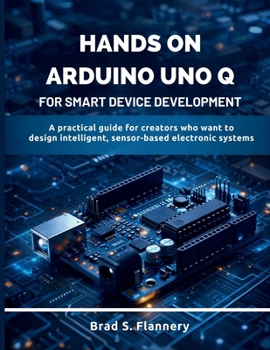
Hands-On Arduino Uno Q for Smart Device Development: A Practical Guide for Creators Who Want to Design Intelligent, Sensor-Based Electronic Systems

Have you ever looked at a smart device and wondered how it actually works behind the scenes? Have you wanted to move beyond simple blinking lights and start building electronic systems that sense, decide, and respond intelligently to their environment? If so, this book was written with you in mind.
Hands-On Arduino Uno Q for Smart Device Development is designed for creators who want more than surface-level tutorials. It speaks directly to learners who are ready to understand why things work, not just how to wire them together. Instead of rushing you through disconnected projects, this guide walks you step by step through the thinking, planning, and engineering practices behind real smart devices.
Do you want to confidently work with sensors rather than copy-paste example code? Are you curious about how raw data becomes meaningful information inside an embedded system? Do timing, power efficiency, reliability, and system behavior sometimes feel confusing or fragmented? This book addresses those questions clearly and patiently, using practical explanations that feel like guidance from an experienced mentor rather than a technical manual.
Inside these pages, you will learn how intelligent electronic systems are structured from the ground up. You will explore electronics fundamentals as they apply to modern smart devices, understand how inputs and outputs interact with control logic, and gain a solid grasp of structured programming practices that keep projects stable and maintainable. Sensor integration is treated as a complete system process-covering calibration, filtering, sampling strategies, and fault detection-so your designs behave predictably in real-world conditions.
Rather than focusing only on experiments, this book encourages you to think like a product developer. You will see how prototypes evolve into reliable devices through proper testing, debugging, power management, and enclosure design. Communication technologies, user interfaces, and system expansion are explained in a way that helps you build scalable projects instead of one-off demonstrations.
Most importantly, this guide respects your intelligence as a learner. It avoids shortcuts that limit understanding and replaces them with clear reasoning, practical examples, and design-focused explanations. Whether you are a student, hobbyist, educator, or independent builder, the goal is the same: to help you gain confidence in designing smart, sensor-based electronic systems that actually work as intended.
If you are ready to stop guessing, stop copying without understanding, and start building intelligent devices with purpose and clarity, this book is your next step forward.
Customer Reviews
ThriftBooks® and the ThriftBooks® logo are registered trademarks of Thrift Books Global, LLC
