


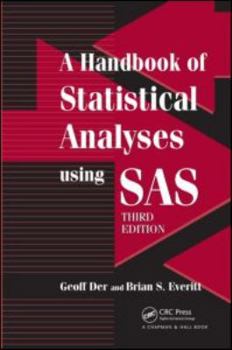
A Handbook of Statistical Analyses Using SAS


Select Format
Select Condition 
Book Overview
Updated to reflect SAS 9.2, A Handbook of Statistical Analyses using SAS, Third Edition continues to provide a straightforward description of how to conduct various statistical analyses using SAS. Each chapter shows how to use SAS for a particular type of analysis. The authors cover inference, analysis of variance, regression, generalized linear models, longitudinal data, survival analysis, principal components analysis, factor analysis, cluster analysis, discriminant function analysis, and correspondence analysis. They demonstrate the analyses through real-world examples, including methadone maintenance treatment, the relation of cirrhosis deaths to alcohol consumption, a sociological study of children, heart transplant treatment, and crime rate determinants. With the data sets and SAS code available online, this book remains the go-to resource for learning how to use SAS for many kinds of statistical analysis. It serves as a stepping stone to the wider resources available to SAS users.
Format:Paperback
Language:English
ISBN:1584887842
ISBN13:9781584887843
Release Date:April 2013
Publisher:CRC Press
Length:416 Pages
Weight:1.33 lbs.
Dimensions:1.0" x 6.0" x 9.0"
Customer Reviews
5 ratings
applications illustrated in SAS
Published by Thriftbooks.com User , 18 years ago
Brian Everitt is the author of several very well-written statistical texts. Among them he has written a number that show how to implement statistical analyses usimg statistical software packages. This second edition of "A Handbook of Statistical Analyses using SAS" he has coauthored with Geoff Der. As a SAS user, I find this book very handy along with other similar texts that I have on the use of SAS. What is particularly good about this book is that it serves as a guide to the use of various SAS procedures and also as an illustration of appropriate statistical approaches to real applications using SAS. It starts out with a nice introduction to the SAS prrogramming language and its syntax and progresses through simple descriptive statistics to categorical data analysis to regression and analysis of variance and then on to more advanced topics, including survival analysis, logistic regression, generalized linear models,longitudinal data analysis, principle components, factor analysis and cluster analysis. Appendices provide SAS MACROs and SAS solutions to exercises in the text. What is particularly good about this book, that may set it apart from some of the others, is the expert statistical advice about the implementation and interpretation of results in SAS. They provide excellent scholarly references to the statistical literature to support their advice. As an example, I particularly liked their discussion of Type I and Type III sum of squares in the analysis of variance. They give a clear explanation of what each means and when they are equivalent and when they are different. In addition, they present their own view as to which is the appropriate one to use in given situations and support their view with quotes from other researchers. Opposing positions are also mentioned and referenced.
Nice book but you need to know the subject!
Published by Thriftbooks.com User , 20 years ago
This is a nice book if you know the subject from another book ! - otherwise the explanation is limited.
Good If you know your Statistics
Published by Thriftbooks.com User , 21 years ago
This is a good book if you know statistical analysis. Do you know what to use, when and where? If you do, this book is good because if you are going to use SAS for analysis you have got to know your statistics. What good would FORTRAN be if you didn't know Algebra? You need both.
Very readable and practical
Published by Thriftbooks.com User , 22 years ago
This book is very well written. Each topic is presented with an interesting example, including discussion. None of the topics are presented in great depth, so for example, this is not the book to use for learning factor analysis, or cluster analysis, etc. The real strength of the book is that it shows how to do the analysis using SAS in a clear and concise way. I would recommend this book highly for anyone who would like to get started using SAS.
Good overview of implementations and methods
Published by Thriftbooks.com User , 23 years ago
This book is a good overview of how to implement in SAS some of the statistical methods you've probably already read about. I had done a lot of reading on factor analysis and clustering for my dissertation and needed a way to implement these methods in SAS. This book explains each method, then shows how to implement it using SAS. The data sets are from "The Handbook of Small Data Sets", which I got from my local university library. As I am a computer scientist and not a statistician, I found this book very helpful in putting together **the idea** of a particular statistical technique with the actual **implementation** of that technique. I have the first edition of this book also, and the second edition is much improved (especially the chapters on clustering and factor analysis).
Copyright © 2026 Thriftbooks.com Terms of Use
| Privacy Policy | Do Not
Sell/Share My Personal Information | Cookie Policy | Cookie Preferences | Accessibility Statement
ThriftBooks® and the ThriftBooks® logo are registered trademarks of Thrift Books Global, LLC
ThriftBooks® and the ThriftBooks® logo are registered trademarks of Thrift Books Global, LLC
