


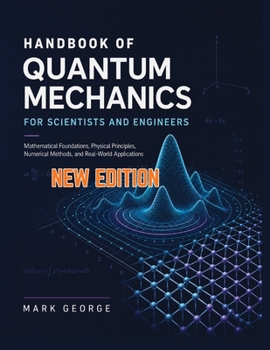
Handbook of Quantum Mechanics for Scientists and Engineers: Mathematical Foundations, Physical Principles, Numerical Methods, and Real-World Applicati
No Customer Reviews

Quantum mechanics becomes difficult not because any single equation is impossible, but because the mathematics, physical interpretation, approximation choices, and engineering consequences must all remain consistent at the same time. Technical readers often meet the subject in fragments: a wave equation in one course, operator methods in another, tunneling in a device context, numerical solvers in software, and noise or coherence limits only much later. The result can be a collection of formulas without a dependable workflow for deciding what model to use, what assumptions matter, or how to check whether an answer is physically trustworthy.
This handbook brings those pieces together in a structured progression from foundations to engineered systems. It develops the mathematical language of states and amplitudes, explains measurement and uncertainty, works through confinement and transmission problems, builds approximation techniques for systems without closed-form solutions, and then extends the framework to mixed states, environmental coupling, computation, nanoscale devices, sensing, control, and system-level performance.
Inside, readers will learn how to: Move confidently between abstract state-space reasoning and coordinate-based calculations;Connect boundary conditions, normalization, conservation, and probability flow to physically admissible solutions;Choose among exact, approximate, and computational approaches according to the scale and structure of a problem;Test analytical and numerical results using dimensions, residuals, convergence, symmetry, limiting cases, and conservation laws;Interpret noise, relaxation, dephasing, correlations, and coherence as engineering constraints rather than isolated concepts;Connect microscopic state behavior to observable device and system performance.Key coverage includes mathematical foundations, wave dynamics, operators and measurement, uncertainty, one-dimensional systems, angular momentum and spin, central-potential systems, stationary and driven approximations, particle statistics, density-operator methods, entanglement, open-system dynamics, numerical solution methods, information processing, solid-state and nanoscale structures, and integrated sensing and control architectures.
The book is written for upper-level students, graduate technical readers, scientists, and practicing engineers who already know calculus, differential equations, complex numbers, and basic linear algebra and want a rigorous reference that stays connected to practical modeling. Add this handbook to your technical library and build a more unified way to formulate, solve, verify, and interpret quantum problems from first principles through engineering application.
This handbook brings those pieces together in a structured progression from foundations to engineered systems. It develops the mathematical language of states and amplitudes, explains measurement and uncertainty, works through confinement and transmission problems, builds approximation techniques for systems without closed-form solutions, and then extends the framework to mixed states, environmental coupling, computation, nanoscale devices, sensing, control, and system-level performance.
Inside, readers will learn how to: Move confidently between abstract state-space reasoning and coordinate-based calculations;Connect boundary conditions, normalization, conservation, and probability flow to physically admissible solutions;Choose among exact, approximate, and computational approaches according to the scale and structure of a problem;Test analytical and numerical results using dimensions, residuals, convergence, symmetry, limiting cases, and conservation laws;Interpret noise, relaxation, dephasing, correlations, and coherence as engineering constraints rather than isolated concepts;Connect microscopic state behavior to observable device and system performance.Key coverage includes mathematical foundations, wave dynamics, operators and measurement, uncertainty, one-dimensional systems, angular momentum and spin, central-potential systems, stationary and driven approximations, particle statistics, density-operator methods, entanglement, open-system dynamics, numerical solution methods, information processing, solid-state and nanoscale structures, and integrated sensing and control architectures.
The book is written for upper-level students, graduate technical readers, scientists, and practicing engineers who already know calculus, differential equations, complex numbers, and basic linear algebra and want a rigorous reference that stays connected to practical modeling. Add this handbook to your technical library and build a more unified way to formulate, solve, verify, and interpret quantum problems from first principles through engineering application.
Format:Paperback
Language:English
ISBN:B0HHFDQZ8N
ISBN13:9798171146047
Release Date:September 2026
Publisher:Independently Published
Length:502 Pages
Weight:2.54 lbs.
Dimensions:1.0" x 8.5" x 11.0"
Related Subjects
Engineering Science Science & Math Science & Scientists Science & Technology TechnologyCustomer Reviews
0 rating
Copyright © 2026 Thriftbooks.com
Terms of Use | Privacy Policy | Do Not Sell/Share My Personal Information | Cookie Notice | Cookie Preferences | Accessibility Statement
ThriftBooks ® and the ThriftBooks ® logo are registered trademarks of Thrift Books Global, LLC
ThriftBooks ® and the ThriftBooks ® logo are registered trademarks of Thrift Books Global, LLC
