


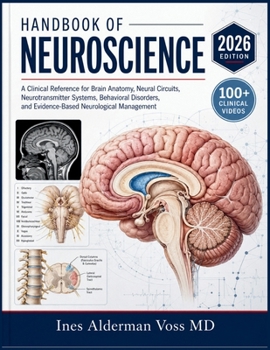
Handbook of Neuroscience: A Clinical Reference for Brain Anatomy, Neural Circuits, Neurotransmitter Systems, Behavioral Disorders, and Evidence-Based

Struggling to connect brain anatomy to what actually happens at the bedside? Most references either drown you in isolated facts or skip straight to disease without ever building the circuit-level understanding that makes the pathology make sense.
That gap costs time in clinic, on rounds, and at the boards. Without a clear mental map from neuron to network to syndrome, differentials stay fuzzy and localization takes guesswork instead of logic.
This 2026 edition closes that gap in a single, structured volume. Twenty-five chapters move systematically from cellular physiology and neurotransmitter pharmacology through gross neuroanatomy, the neurological examination, and the major clinical syndromes of adult neurology and neuropsychiatry.
Cellular and synaptic physiology, action potentials, and neurotransmitter systems explained mechanisticallyFull gross neuroanatomy: hemispheres, diencephalon, basal ganglia, brainstem, cranial nerves, cerebellum, and spinal pathwaysLocalization-based approach to the neurological examinationClinical chapters on stroke, epilepsy, movement disorders, demyelinating disease, dementia, neuromuscular disease, neuro-oncology, and psychiatric neuroscienceClinical pearls, case vignettes, and comparison tables throughout every chapterFully labeled clinical illustrations supporting every major conceptA companion video course of over 100 curated lecture videos, accessible instantly by scanning the QR code inside the back coverHandbook of Neuroscience is written for medical students, residents, nurse practitioners, physician assistants, and any clinician who wants neuroanatomy and neurological disease presented as one connected system instead of two separate subjects.
Open to any chapter and start building the clinical reasoning that connects a lesion on imaging to a deficit at the bedside.
Customer Reviews
ThriftBooks ® and the ThriftBooks ® logo are registered trademarks of Thrift Books Global, LLC
