


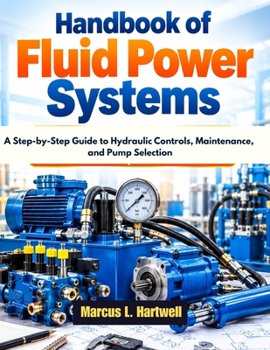
Handbook of Fluid Power Systems: A Step-by-Step Guide to Hydraulic Controls, Maintenance, and Pump Selection
No Customer Reviews

From the press that stamps automotive body panels to the excavator arm that carves a foundation, hydraulic power delivers precise, controllable force at a density no other technology matches - and specifying, controlling, and maintaining it correctly takes a governing equation, a checkable calculation, and a specification you can defend. Many engineers and advanced students find their hydraulics resources split between two extremes: textbooks that explain the physics but stop short of a real sizing decision, and field guides that offer procedures without the reasoning behind them. When a pump must be sized for a variable-speed mobile duty cycle, a suction line verified against cavitation, or a repeat pump failure traced to its actual root cause, neither extreme is enough, and the gap gets filled with judgment instead of a verified number. This handbook is built as a single, integrated working reference that carries hydraulic fluid power engineering from governing principle through quantitative analysis to a defensible decision - a linear curriculum from fundamentals through commissioning in which each chapter also stands alone as a self-contained reference, presented throughout in both US customary and SI units. Inside, you will: - Apply Pascal's Law, the continuity equation, and Bernoulli's principle to calculate force, flow velocity, and hydraulic power, with every worked example tracking units at each step. - Work through a pump-selection procedure that carries a load analysis through inlet-condition verification, duty-cycle power calculation, and a total-cost-of-ownership comparison between pump technologies. - Select and specify cylinders, hydraulic motors, and directional, pressure, and flow control valves using sizing methods and failure-mode analysis grounded in each component's governing physics. - Design complete hydraulic circuits with a structured methodology covering accumulator sizing, pressure-zone mapping, and single-point failure analysis. - Specify and commission electrohydraulic position and velocity control loops, including gain analysis, stability margins, and controller tuning. - Apply a structured troubleshooting methodology and root-cause techniques to trace a repeat failure to its actual cause, supported by a maintenance-economics framework for justifying the resulting program. - Specify reservoirs, filtration, heat exchangers, hose, tube, pipe, and fittings, and use the appendices - unit conversion tables, a fluid properties reference, and a full commissioning checklist - as standalone quick-reference tools. This handbook is written for practicing hydraulic, mechanical, and plant engineers who design, specify, or maintain hydraulic equipment; maintenance and reliability engineers and technicians; and advanced engineering students who need a calculation-based reference covering the complete system life cycle. Take the next step toward a working command of hydraulic system design, control, and maintenance: open this comprehensive, calculation-based reference and start building the knowledge this field rewards.
Format:Paperback
Language:English
ISBN:B0HJHL8DQC
ISBN13:9798173315915
Release Date:September 2026
Publisher:Independently Published
Length:384 Pages
Weight:1.96 lbs.
Dimensions:0.8" x 8.5" x 11.0"
Customer Reviews
0 rating
Copyright © 2026 Thriftbooks.com
Terms of Use | Privacy Policy | Do Not Sell/Share My Personal Information | Cookie Notice | Cookie Preferences | Accessibility Statement
ThriftBooks ® and the ThriftBooks ® logo are registered trademarks of Thrift Books Global, LLC
ThriftBooks ® and the ThriftBooks ® logo are registered trademarks of Thrift Books Global, LLC
