


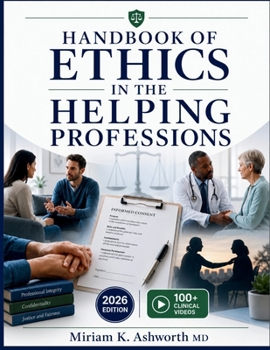
Handbook of Ethics in the Helping Professions: A Practical Reference for Ethical Decision-Making, Professional Boundaries, Dual Relationships, Cultura

An ethics complaint can end a career built over decades in a single afternoon. Most practitioners never see the crisis coming until a dual relationship, a documentation gap, or an unclear reporting duty puts their license on the line.
The problem is that ethics codes are written in abstractions. The NASW, APA, ACA, and AAMFT codes tell you what principles matter, but they rarely walk you through the messy, ambiguous moment when a client friend-requests you, a rural caseload forces an unavoidable dual role, or a supervisee discloses something that triggers a mandatory report.
This 2026 edition closes that gap. Across 25 chapters, it translates professional codes into concrete, defensible decisions for the situations counselors, social workers, psychologists, and marriage and family therapists actually face:
Informed consent, confidentiality limits, and mandatory reporting across child, elder, and duty-to-warn scenariosProfessional boundaries, dual relationships, and digital-era risks in telehealth and social mediaCultural competence with immigrant, refugee, LGBTQ+, pediatric, and older adult populationsSuicide risk, documentation, supervision liability, and licensing board complaint responseMalpractice risk management and a practical framework for building your own ethical decision-making processEach chapter includes clinical vignettes, quick-reference action tables, red-flag warnings, and clarifying illustrations, all anchored to real codes of ethics and case law such as Tarasoff. A companion video course of more than 50 curated lectures is included via QR code, alongside original clinical diagrams throughout.
Whether you are a student preparing for licensure or a seasoned clinician auditing your own practice, this handbook gives you the specific, defensible answer instead of another vague principle.
Customer Reviews
ThriftBooks ® and the ThriftBooks ® logo are registered trademarks of Thrift Books Global, LLC
