


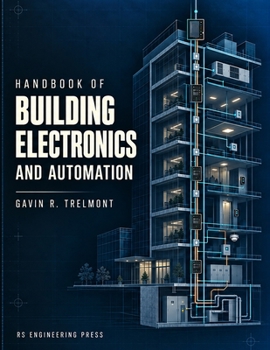
Handbook of Building Electronics and Automation: Advanced Design, Integration, Control, Networking, Cybersecurity, Energy Management, and Intelligent Building Systems
No Customer Reviews

Connected devices do not make an intelligent building. Without a coherent architecture, automation projects become collections of controllers, dashboards, gateways, and cloud services that cannot be explained, tested, secured, or sustained.
This handbook shows how to engineer building automation as a complete cyber-physical system. It connects owner intent, measurable requirements, field electronics, control logic, networks, data, cybersecurity, commissioning, and lifecycle governance-so every layer supports reliable operation.
Use this practical reference to: translate operational goals into specifications, acceptance criteria, and testable evidence;design sensors, actuators, input and output interfaces, power, grounding, protection, and reliable field installations;write explicit sequences, state logic, alarms, overrides, and bounded supervisory control;plan resilient operational networks, integrations, histories, application interfaces, and semantic data models;apply secure architecture, least-privilege access, monitoring, recovery, and continuous assurance;improve heating, ventilation, and air-conditioning performance with supervisory optimization, analytics, and automated fault detection; andcoordinate energy flexibility, modernization, and portfolio decisions without losing command authority or data meaning.Eighteen chapters cover systems architecture; requirements and procurement; field electronics; control software; operational networking; interoperability; building data; cross-domain integration; digital twins; advanced environmental control; analytics; occupant interaction; energy management; cybersecurity; resilience and safety; commissioning; and brownfield modernization. Reusable worksheets, audit matrices, quick references, and a detailed index support design reviews, field verification, and long-term operations.
The method follows a complete chain of evidence: goals become requirements; requirements become interfaces, sequences, and network decisions; implementation becomes observable through points, histories, alarms, and tests; and verified performance becomes an operating baseline. Failure behavior, overrides, recovery, ownership, and staged upgrades are addressed alongside normal operation, helping teams resolve root causes and preserve useful installed assets.
The book is written for engineers, controls designers, system integrators, commissioning professionals, facility technology and energy leaders, consultants, technical managers, and advanced students. Readers should already understand basic circuits, sensors, actuators, direct digital control, introductory feedback control, heating and cooling systems, and network fundamentals.
If you need a defensible way to connect design intent with software behavior, operating evidence, security, and lifecycle value, this handbook provides the architecture and methods to do it. Build systems that can be understood, verified, adapted, and trusted.
This handbook shows how to engineer building automation as a complete cyber-physical system. It connects owner intent, measurable requirements, field electronics, control logic, networks, data, cybersecurity, commissioning, and lifecycle governance-so every layer supports reliable operation.
Use this practical reference to: translate operational goals into specifications, acceptance criteria, and testable evidence;design sensors, actuators, input and output interfaces, power, grounding, protection, and reliable field installations;write explicit sequences, state logic, alarms, overrides, and bounded supervisory control;plan resilient operational networks, integrations, histories, application interfaces, and semantic data models;apply secure architecture, least-privilege access, monitoring, recovery, and continuous assurance;improve heating, ventilation, and air-conditioning performance with supervisory optimization, analytics, and automated fault detection; andcoordinate energy flexibility, modernization, and portfolio decisions without losing command authority or data meaning.Eighteen chapters cover systems architecture; requirements and procurement; field electronics; control software; operational networking; interoperability; building data; cross-domain integration; digital twins; advanced environmental control; analytics; occupant interaction; energy management; cybersecurity; resilience and safety; commissioning; and brownfield modernization. Reusable worksheets, audit matrices, quick references, and a detailed index support design reviews, field verification, and long-term operations.
The method follows a complete chain of evidence: goals become requirements; requirements become interfaces, sequences, and network decisions; implementation becomes observable through points, histories, alarms, and tests; and verified performance becomes an operating baseline. Failure behavior, overrides, recovery, ownership, and staged upgrades are addressed alongside normal operation, helping teams resolve root causes and preserve useful installed assets.
The book is written for engineers, controls designers, system integrators, commissioning professionals, facility technology and energy leaders, consultants, technical managers, and advanced students. Readers should already understand basic circuits, sensors, actuators, direct digital control, introductory feedback control, heating and cooling systems, and network fundamentals.
If you need a defensible way to connect design intent with software behavior, operating evidence, security, and lifecycle value, this handbook provides the architecture and methods to do it. Build systems that can be understood, verified, adapted, and trusted.
Format:Paperback
Language:English
ISBN:B0HKGWM5RR
ISBN13:9798175937641
Release Date:September 2026
Publisher:Independently published
Length:526 Pages
Weight:2.67 lbs.
Dimensions:11.0" x 1.2" x 8.5"
Customer Reviews
0 rating
Copyright © 2026 Thriftbooks.com
Terms of Use | Privacy Policy | Do Not Sell/Share My Personal Information | Cookie Notice | Cookie Preferences | Accessibility Statement
ThriftBooks ® and the ThriftBooks ® logo are registered trademarks of Thrift Books Global, LLC
ThriftBooks ® and the ThriftBooks ® logo are registered trademarks of Thrift Books Global, LLC
