


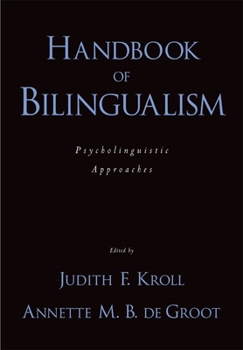
Handbook of Bilingualism: Psycholinguistic Approaches
No Customer Reviews

How is language acquired when infants are exposed to multiple language input from birth and when adults are required to learn a second language after early childhood? How do adult bilinguals comprehend and produce words and sentences when their two languages are potentially always active and
in competition with one another? What are the neural mechanisms that underlie proficient bilingualism? What are the general consequences of bilingualism for cognition and for language and thought? This handbook will be essential reading for cognitive psychologists, linguists, applied linguists, and
educators who wish to better understand the cognitive basis of bilingualism and the logic of experimental and formal approaches to language science.
in competition with one another? What are the neural mechanisms that underlie proficient bilingualism? What are the general consequences of bilingualism for cognition and for language and thought? This handbook will be essential reading for cognitive psychologists, linguists, applied linguists, and
educators who wish to better understand the cognitive basis of bilingualism and the logic of experimental and formal approaches to language science.
Format:Hardcover
Language:English
ISBN:0195151771
ISBN13:9780195151770
Release Date:February 2009
Publisher:Oxford University Press, USA
Length:610 Pages
Weight:2.75 lbs.
Dimensions:2.0" x 7.3" x 10.0"
Customer Reviews
0 rating
Copyright © 2025 Thriftbooks.com
Terms of Use | Privacy Policy | Do Not Sell/Share My Personal Information | Cookie Policy | Cookie Preferences | Accessibility Statement
ThriftBooks ® and the ThriftBooks ® logo are registered trademarks of Thrift Books Global, LLC
ThriftBooks ® and the ThriftBooks ® logo are registered trademarks of Thrift Books Global, LLC
