


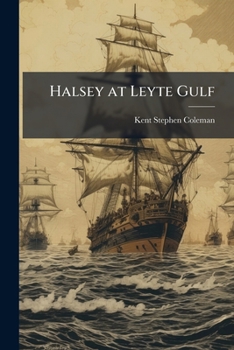
Halsey at Leyte Gulf: Command Decision and Disunity of Effort

In October 1944, US forces executed amphibious landings on the Japanese-occupied island of Leyte in the central Philippines. Japanese naval forces, severely outnumbered by the US Third and Seventh Fleets, attempted to stop the invasion by attacking US amphibious shipping in Leyte Gulf. Due to the divided US area commands in the Pacific theater during World War II, the Third and Seventh Fleet commanders, Adm. Halsey and Vice Adm. Kinkaid, reported to separate superiors, Adm. Nimitz and Gen. MacArthur, even though both fleets were supporting the operation. Although the Japanese were soundly defeated, one of the Japanese forces, under Vice Adm. Kurita, nearly reached its objective. Many historians have criticized Halsey for ordering his carrier force to close with a Japanese carrier force that was acting as a decoy, thus leaving the US forces in Leyte Gulf unprotected. Although Halsey was effectively decoyed, the divided US naval chain of command amplified problems in communication and coordination between Halsey and Kinkaid. This divided command was more important in determining the course of the battle than the tactical decision made by Halsey and led to an American disunity of effort that nearly allowed Kurita's mission to succeed.
This work has been selected by scholars as being culturally important, and is part of the knowledge base of civilization as we know it. This work was reproduced from the original artifact, and remains as true to the original work as possible. Therefore, you will see the original copyright references, library stamps (as most of these works have been housed in our most important libraries around the world), and other notations in the work.
This work is in the public domain in the United States of America, and possibly other nations. Within the United States, you may freely copy and distribute this work, as no entity (individual or corporate) has a copyright on the body of the work.
As a reproduction of a historical artifact, this work may contain missing or blurred pages, poor pictures, errant marks, etc. Scholars believe, and we concur, that this work is important enough to be preserved, reproduced, and made generally available to the public. We appreciate your support of the preservation process, and thank you for being an important part of keeping this knowledge alive and relevant.
Customer Reviews
ThriftBooks ® and the ThriftBooks ® logo are registered trademarks of Thrift Books Global, LLC
