


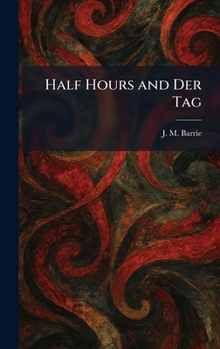
Half Hours and Der Tag

"Half Hours and Der Tag" brings together a compelling collection of one-act plays by the celebrated dramatist J. M. Barrie, best known for his creation of "Peter Pan". This volume showcases Barrie's versatility and mastery of the short-form drama, blending sharp social commentary with poignant human insight and speculative historical fiction.
The collection titled "Half Hours" features some of Barrie's most beloved shorter works, including "The Twelve-Pound Look", a witty and subversive take on marriage and independence, and "The Will", a sobering look at how greed can erode youthful ideals. These plays are characterized by their tight pacing, economical storytelling, and the delicate balance of humor and pathos that defined the Edwardian stage.
Accompanying these is "Der Tag", a powerful and contemplative piece written during the early stages of World War I. This play provides a psychological portrait of a ruler at a historical crossroads, exploring themes of power, duty, and the tragic consequences of global conflict. Together, these works highlight Barrie's keen eye for character and his ability to address complex social and political themes within the intimate scope of the one-act play, making this collection an essential read for fans of early 20th-century theatre and classic literature.
This work has been selected by scholars as being culturally important, and is part of the knowledge base of civilization as we know it. This work was reproduced from the original artifact, and remains as true to the original work as possible. Therefore, you may see the original copyright references, library stamps (as most of these works have been housed in our most important libraries around the world), and other notations in the work.
This work is in the public domain in the United States of America, and possibly other nations. Within the United States, you may freely copy and distribute this work, as no entity (individual or corporate) has a copyright on the body of the work.
As a reproduction of a historical artifact, this work may contain missing or blurred pages, poor pictures, errant marks, etc. Scholars believe, and we concur, that this work is important enough to be preserved, reproduced, and made generally available to the public. We appreciate your support of the preservation process, and thank you for being an important part of keeping this knowledge alive and relevant.
Customer Reviews
ThriftBooks® and the ThriftBooks® logo are registered trademarks of Thrift Books Global, LLC
