


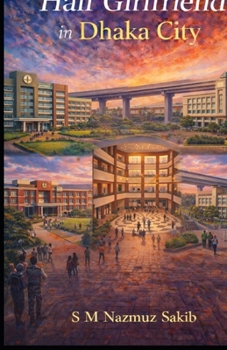
Half Girlfriend in Dhaka City

Nasim Ahmed has three things when he arrives at North South University: a full scholarship, a single bag of clothes, and the specific integrity of a boy raised by a man who sold hardware for twenty-two years without once cheating a customer. He is tall, honest, and completely unprepared for a city that measures people in ways his hometown never did.
Jannat Hossain is everything Dhaka's upper-middle class produces when it is working correctly. Gulshan address, good family, her own car, and a version of feminism assembled from social media, selective reading, and a mother who taught her, without ever meaning to, that a woman's standards are her most important possession.
When they meet at a glass door Nasim walks into on his first week at university, something begins that neither of them knows how to hold.
She calls it friendship. He lives inside it like it is everything. For a year and a half he is her most important person in the most incomplete way possible, always present, never chosen, the scholarship boy from Sylhet who understands her better than anyone and does not fit the category she has been building since childhood.
But Nasim Ahmed refuses to become smaller than he is. And Jannat Hossain, beneath the framework she inherited and the language she borrowed and the group chat that confirmed everything she wanted confirmed, is capable of something the story takes four years to produce: the courage to examine what she was given and choose differently.
It is about the specific exhaustion of being loved halfway. It is about the invisible tax levied on boys who come from the wrong side of a city's social geography and love the right kind of woman. It is about the way feminist language, wielded without precision, can become a weapon aimed at the exact people it was never meant for. It is about a Gulshan girl who calls herself progressive and exercises hypergamy without knowing the word for it. It is about the machine that converts complicated feelings into simple judgments and the damage the machine does on its way to producing certainty.Half Girlfriend in Dhaka City follows Nasim and Jannat from their first accidental meeting through four years of university, a fellowship abroad, two families negotiating across a class divide, a mother's fear dressed up as standards, a father's quiet wisdom, and the long slow work of two people learning to see each other fully.
It asks questions that the original Half Girlfriend left on the table: What happens when the girl's world is the problem, not just the gap between them? What does it cost a man to love a woman who is still becoming ready to be loved by him? And what does it look like when a woman does the real work, not the performed version, but the actual interior examination, of becoming someone who deserves what she has been given?
Customer Reviews
ThriftBooks® and the ThriftBooks® logo are registered trademarks of Thrift Books Global, LLC
