


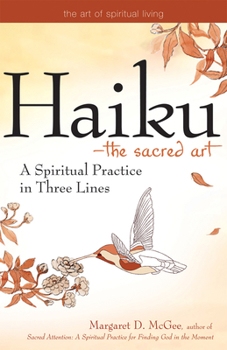
Haiku--The Sacred Art: A Spiritual Practice in Three Lines


Select Format
Select Condition 
Book Overview
Takes the mystery and intimidation out of beginning to write haiku as a spiritual practice. Provides helpful hints and step-by-step exercises to broaden and deepen both your haiku artistry and your... This description may be from another edition of this product.
Format:Paperback
Language:English
ISBN:1594732698
ISBN13:9781594732690
Release Date:October 2009
Publisher:Skylight Paths Publishing
Length:194 Pages
Weight:0.55 lbs.
Dimensions:0.5" x 5.6" x 8.5"
Customer Reviews
5 ratings
"A Rich Little Book"
Published by Thriftbooks.com User , 15 years ago
[ This review originally appeared in The Englewood Review of Books - 18 June 2010 ] Haiku has long been one of my favorite forms of poetry: short and simple enough to be written in one sitting, and yet spare; its brevity offering gentle discipline when I often am tempted to wax verbose. So, I was delighted to find out about Margaret McGee's recent book Haiku, the Sacred Art: A Spiritual Practice in Three Lines, a superb exploration of this poetic form for both beginners and experts alike. In the book's introduction, McGee notes that haiku is intended to depict a single image, "a picture in the mind's eye." She describes "the haiku moment" as "a moment when the mind stops and the heart moves." Thus, the practice of writing haiku is necessarily a practice of slowing down and of attentiveness, of focusing on a single object and the feelings that it stirs up inside of us. McGee also emphasizes that haiku is more about the experience than about the final written product. Drawing on these themes throughout, McGee explores how haiku can become a spiritual, contemplative practice. Specifically, she focuses on how the experience of haiku captures "the heart of a moment," how haiku can be a form of prayer, and the ways in which writing and sharing haiku with others can be a rich community-building experience. The most engaging chapter in the book, however, was McGee's reflection on combining the practices of haiku and Lectio Divina (a meditative way of reading and reflecting upon scripture; for those unfamiliar, I would highly recommend Tony Jones's book, Divine Intervention) Lectio Divina combined with haiku can help us to internalize passages of scripture that we might take them out into the world with us. "When you carry the words of sacred texts out into the world with you," she says, "and look with attention, you may see the words reflected back to you in the common events and objects of daily life" (92). Practices of internalizing scripture have been well-known among monastics (and other faithful ones) for centuries - and especially in the era before the printing press made texts widely available - but McGee's thought to combine haiku with reflection upon scripture is one that will undoubtedly be kicking around my head for a long while. One of the book's final chapters reflects the "presentation" aspect of how haiku are written, specifically how they can be incorporated with pictures or prose. Haiku, the Sacred Art: A Spiritual Practice in Three Lines is a rich little book, calling us into practices of attention and reflection that are lost arts in most corners of mainstream American culture. I have no doubt that, if we would attend seriously to the ideas set forth here, we would be better prepared to hear that "still small voice" that seeks to transform us (and all creation) from the inside out.
Haiku
Published by Thriftbooks.com User , 16 years ago
An excellent book that continues to hold my interest. I have shared my copy with others and have bought one for friends I use the examples for a lecture series I am giving. It is a great book!
Haiku with guts
Published by Thriftbooks.com User , 16 years ago
This is haiku with guts. I love, "A haiku takes us down to the bones of a moment." And "...when it comes to learning something new, cluelessness turns out to be the perfect and only place to start." I like it that this is a book to READ, not just a bunch of instructions. It's the spiritual equivalent of From Julia Child's Kitchen, where you not only get the bread recipe, you travel to the bakeries in Nice and experience the 300 days of experimental baking. I love McGee's image of a first kiss in puffy parkas on a Midwest winter night. And I put the book to work, as you can read about at [...] And it's going to be the book I use this year for a Lenten practice. Highly recommended.
haiku--poetry and spiritual practice
Published by Thriftbooks.com User , 16 years ago
Margaret McGee's book on haiku names it as "sacred art" and as "spiritual practice." As a long-time writer of haiku, I welcome the invitation to see haiku not just as short nature poems based on a Japanese tradition (in three lines of roughly 5, 7, and 5 syllables), but as a form particularly useful to those who have a spiritual outlook. In her very readable 145 pages of text, the author suggests ways to see haiku as a way to capture "the heart of a moment," especially a moment of close observation of the natural world. She also sees haiku as a form of "simple prayer," and encourages experimenting with a form that "turns the focus from the all-consuming Me and instead shares one fleeting glimpse of the ever-present Spirit..." Her suggestions and examples make the writing of haiku accessible to all, and her guidelines for group writing and sharing are workable and useful. She includes ideas on how combine haiku and drawings or designs, and explains the art of haibun,a mixture of haiku and prose. Her book is enjoyable to read, with short quotations from many spiritual traditions included on many pages. The design of the book is pleasing and welcoming.
A top pick for any poetry collection
Published by Thriftbooks.com User , 16 years ago
The power of the haiku is not in its format, but forcing people to put their thoughts in ways that are simple and brief. "Haiku - The Sacred Art: A Spiritual Practice in Three Lines" discusses the spirituality that comes with the Haiku, the Japanese based tradition that many have adapted as a way of spiritual expression. Encouraging readers to use haikus themselves to express themselves further, "Haiku" is a top pick for any poetry collection focusing on the creating one's own and the reasons why.
Copyright © 2026 Thriftbooks.com Terms of Use
| Privacy Policy | Do Not
Sell/Share My Personal Information | Cookie Policy | Cookie Preferences | Accessibility Statement
ThriftBooks® and the ThriftBooks® logo are registered trademarks of Thrift Books Global, LLC
ThriftBooks® and the ThriftBooks® logo are registered trademarks of Thrift Books Global, LLC
