


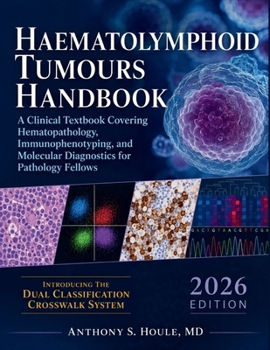
Haematolymphoid Tumours Handbook 2026: A Clinical Textbook Covering Hematopathology, Immunophenotyping, and Molecular Diagnostics for Pathology Fellow

Know Where WHO-HAEM5 and the ICC Agree, and Exactly Where They Don't
Built for the hematopathology fellow and pathology resident reconciling two classification systems at every sign-out, this reference connects normal hematopoiesis and lymphoid development to the morphologic, immunophenotypic, cytogenetic, and molecular criteria that define each entity under both WHO-HAEM5 and the International Consensus Classification. It moves from essential-versus-desirable diagnostic reasoning and flow cytometric lineage assignment through the full range of myeloid, lymphoid, histiocytic, and plasma cell neoplasms to the genetic tumor syndromes that predispose to them. A Dual Classification Crosswalk System, built into every chapter and consolidated into a closing Atlas, names the specific finding each Reporting Anchor requires so the diagnosis holds under either system.
At the Scope and in the Report, You Will
- Apply essential-versus-desirable reasoning to resolve a case when a cytogenetic study fails or a molecular result is pending.
- Score mixed-phenotype acute leukemia and distinguish hematogones from B-lymphoblastic leukemia using the same maturation-gradient logic.
- Read a genetically defined AML diagnosis correctly, including the myelodysplasia-related gene and cytogenetic lists where WHO-HAEM5 and the ICC genuinely disagree.
- Crosswalk the CML accelerated-phase question and know what to write when a category exists under one classification but not the other.
- Diagnose across the mature lymphoma spectrum, CLL through Burkitt and Hodgkin, each anchored to its essential criteria.
- Distinguish reversible post-transplant lymphoproliferative disease from the monomorphic lesion that requires conventional treatment.
- Recognize favorable pediatric variants, including transient abnormal myelopoiesis, that prevent overtreating a child's disease.
- Flag germline TP53, RUNX1, and DDX41 predisposition the moment paired-tissue testing confirms it.
Open it before your next sign-out: the classification your patient's diagnosis depends on, resolved either way.
Customer Reviews
ThriftBooks ® and the ThriftBooks ® logo are registered trademarks of Thrift Books Global, LLC
