


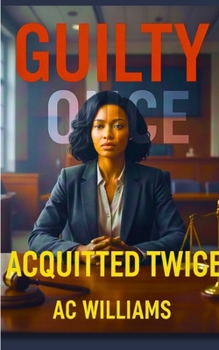
Guilty Once, Acquitted Twice

When Coincidence Becomes Suspicious: The Question at the Heart of Guilty Once, Acquitted Twice
How many tragedies can happen to one person before society stops believing in bad luck?
That question sits at the center of Guilty Once, Acquitted Twice, where Amina Lucille Washington once again finds herself sitting in a courtroom-not as a witness, not as a grieving widow-but as a defendant.
Years earlier, Amina stood trial for the death of her first husband, a death caused by a gunshot wound. She was acquitted. The court determined the death was accidental. Life moved forward-or at least attempted to.
Now history appears to be repeating itself.
Her second husband is dead after falling down a flight of stairs. Once again, Amina was present. Once again, investigators initially considered the death accidental. And once again, suspicion finds its way back to her.
But courts do not operate in a vacuum.
In an era captivated by sensational headlines, true crime documentaries, and endless discussions about spouses who deceive, manipulate, and kill, coincidence itself begins to look suspicious. Public opinion quietly enters the courtroom long before opening statements begin.
At what point does tragedy become evidence?
This is the uncomfortable question Guilty Once, Acquitted Twice asks readers to confront.
The novel is not simply about whether Amina Lucille Washington is guilty or innocent. It explores something more unsettling: how race, gender, appearance, and public perception influence what we believe before facts are fully presented.
The courtroom becomes more than a setting. It becomes a mirror.
Jurors enter carrying life experiences, assumptions, biases, fears, and personal beliefs. So do prosecutors. So do reporters covering the case. So do readers.
Would people view Amina differently if she looked different?
Would the public react differently if the victims were women instead of men?
Would two unrelated tragedies feel less suspicious if they happened years apart-or more suspicious because they happened at all?
These questions do not have simple answers.
What makes Amina's story compelling is not merely the mystery surrounding two deaths. It is watching how quickly narratives form around people when facts feel incomplete.
Humans naturally search for patterns. We want stories to make sense. Randomness feels uncomfortable. Coincidence feels unsatisfying.
So when one woman stands at the center of two separate tragedies, society begins asking whether bad luck is possible-or whether something darker must explain the pattern.
Perhaps the greatest challenge facing Amina is not the evidence itself.
Perhaps it is overcoming what people have already decided.
Guilty Once, Acquitted Twice invites readers into a courtroom drama where testimony matters, evidence matters, but perception may matter even more.
And when the jury finally deliberates, they must answer the same question readers have been asking from the beginning:
How many accidents are people willing to believe?
Customer Reviews
ThriftBooks ® and the ThriftBooks ® logo are registered trademarks of Thrift Books Global, LLC
