


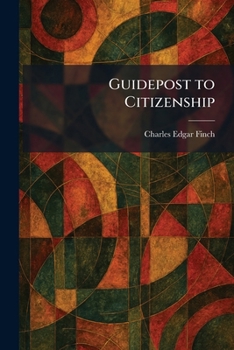
Guidepost to Citizenship

Select Format
Select Condition 
Book Overview
"Guidepost to Citizenship" is a comprehensive instructional work focused on the essential principles of civic duty and participation in a democratic society. Written by Charles Edgar Finch, this text serves as a foundational roadmap for individuals seeking to understand the rights, privileges, and responsibilities associated with citizenship. The book explores the structure of government, the importance of law and order, and the role of the individual in fostering a healthy community. Through clear prose and structured lessons, Finch aims to cultivate a sense of informed patriotism and ethical conduct in his readers.
By examining the mechanics of social cooperation and the historical context of American governance, the work provides a timeless look at how civic values were articulated and maintained in the early twentieth century. "Guidepost to Citizenship" is an invaluable resource for students of political history, educators, and anyone interested in the development of social studies curriculum. It emphasizes the development of character alongside the acquisition of political knowledge, framing citizenship not just as a legal status, but as a moral commitment to the public welfare and the continuous improvement of society.
This work has been selected by scholars as being culturally important, and is part of the knowledge base of civilization as we know it. This work was reproduced from the original artifact, and remains as true to the original work as possible. Therefore, you may see the original copyright references, library stamps (as most of these works have been housed in our most important libraries around the world), and other notations in the work.
This work is in the public domain in the United States of America, and possibly other nations. Within the United States, you may freely copy and distribute this work, as no entity (individual or corporate) has a copyright on the body of the work.
As a reproduction of a historical artifact, this work may contain missing or blurred pages, poor pictures, errant marks, etc. Scholars believe, and we concur, that this work is important enough to be preserved, reproduced, and made generally available to the public. We appreciate your support of the preservation process, and thank you for being an important part of keeping this knowledge alive and relevant.
Customer Reviews
ThriftBooks ® and the ThriftBooks ® logo are registered trademarks of Thrift Books Global, LLC
