


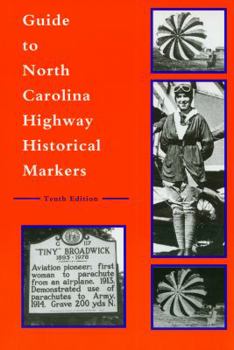
Guide to North Carolina Highway Historical Markers


Select Format
Select Condition 
Book Overview
This tenth revised edition of the popular marker guide contains inscriptions on 1,513 markers erected across the state between 1935 and 2007. The markers are conveniently grouped by county, and the counties are arranged alphabetically. Included are separate maps for each of the 100 counties and 107 additional illustrations.
Format:Paperback
Language:English
ISBN:0865263280
ISBN13:9780865263284
Release Date:January 1939
Publisher:North Carolina Division of Archives & History
Length:280 Pages
Weight:1.50 lbs.
Dimensions:1.0" x 6.5" x 10.0"
Customer Reviews
1 rating
Roadside North Carolina
Published by Thriftbooks.com User , 17 years ago
Ninth Edition. Buried amongst too many signs honoring obscure 1-term politicians and local businessmen, "Washington [and Jeff Davis] slept here" locations, and churches and clergy with no known historic or religious value, are gems that beg for more research: --There is a town named Tar Heel, NC --Desoto AND Juan Pardo (related to Don?) led separate Spanish expeditions through the region to become North Carolina, including over the Smoky Mountains. --NC was the leading gold-mining state until overtaken by some other state in an apparently insignificant historical event that took place in 1849. --NC was an apparent haven for Siamese twins--in addition to Chang and Eng were the Mckoy twins. Says the marker laconicly: "Black Siamese twins born near here, 1851. Exhibited in U.S. and Europe. Died in 1912." So, they were born in 1851 near Whiteville, toured Europe and the US, and lived to be 63--and they were black, born in 1851, in the south. Were they born to slaves? Did they remain slaves as they toured? How did they get medical treatment to survive? Were they compared to Chang and Eng? Did they tour with Chang and Eng? How were they treated compared to Change and Eng? --The James Adams Floating Theater traveled the coastal towns of NC from 1913 to 1941, and was the inspiration for Edna Ferber's novel "Show Boat." What was life like on that boat? The photograph shows a large 3-story clapboard theater on a barge. How did it navigate? How did it meet its demise? --Brunswick was founded in 1725, attacked by the Spanish in 1748 (who briefly captured Beaufort in 1747!), was the site of Stamp Act resistance in 1766, then "Later abandoned". A 1769 map reproduced in the book shows a medium-sized (for its time) coastal town laid out in neat squares. Why was it abandoned? Is it a ghost town? Was it destroyed by flood? --Sign C-7 identifies otherwise unknown Richard Dobbs Spaight and his son Jr. Senior Spaight signed the Constitution and served one term as governor from 1792-1795. Then, a page later, sign C-39 is headlined "POLITICAL DUEL: John Stanley killed Richard Dobbs Spaight, former governor of North Carolina, in a duel near this spot, September 5, 1802." How can the first sign make no mention of the duel!? Surely there's a story to tell here. --Babe Ruth hit his first professional home run in Fayetteville (named for Lafayette) and got his nickname here. --The Battle of Bentonville (you need to hear a local pronounce that name to understand how different the English language can sound filtered through local dialects) was the last major battle of the Civil War, the largest battle fought on NC soil, and the last attempt to stop Sherman's march through the South. Much of the maneuvering took place on highways and roads around and through Aversboro, not far from where I live. --In a northward migration never repeated since, Nathaniel Rochester, Revolutionary War hero, moved to New York and gave his name to the city he fou
Copyright © 2026 Thriftbooks.com
Terms of Use | Privacy Policy | Do Not Sell/Share My Personal Information | Cookie Policy | Cookie Preferences | Accessibility Statement
ThriftBooks ® and the ThriftBooks ® logo are registered trademarks of Thrift Books Global, LLC
ThriftBooks ® and the ThriftBooks ® logo are registered trademarks of Thrift Books Global, LLC
