


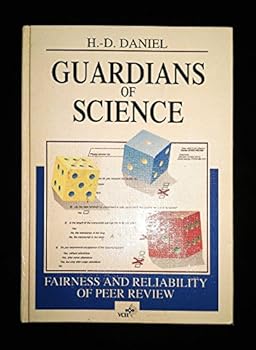
Guardians of Science: Fairness and Reliability of Peer Review
No Customer Reviews

Ever got a paper rejected? And have you wondered whether the mysterious process behind the editor's decision was fair and reliable? For many years, renowned scientific journals have resorted to peer review as the best available means of separating the wheat from the chaff in science publishing. But is peer review really fair, reliable and unbiased? And does it prevent fraud in science, or hinder innovative research? In this book H.-D. Daniel presents a detailed investigation into the peer review system of Angewandte Chemie, one of the world's leading chemistry journals. In particular, his analysis focuses on the * content and level of agreement of referee reports * fate and impact of papers rejected by Angewandte Chemie and published elsewhere * level of bias involved in editorial and reviewers' decisions and based on incidental aspects, such as nationality, academic title and subject area of a paper's author(s). Scientists - who must publish (or perish) -, editors and all non- specialists interested in the controversial issue of quality control in science will be fascinated by this case study.
Format:Hardcover
Language:English
ISBN:3527290419
ISBN13:9783527290413
Release Date:October 1993
Publisher:Wiley-VCH
Length:109 Pages
Weight:0.94 lbs.
Dimensions:9.8" x 0.6" x 6.9"
Customer Reviews
0 rating
Copyright © 2026 Thriftbooks.com Terms of Use
| Privacy Policy | Do Not
Sell/Share My Personal Information | Cookie Policy | Cookie Preferences | Accessibility Statement
ThriftBooks® and the ThriftBooks® logo are registered trademarks of Thrift Books Global, LLC
ThriftBooks® and the ThriftBooks® logo are registered trademarks of Thrift Books Global, LLC
