


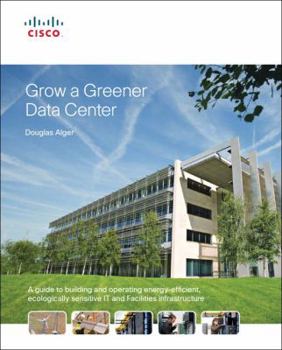
Grow a Greener Data Center


Grow a Greener Data Center ? A guide to building and operating energy-efficient, ecologically sensitive IT and Facilities infrastructure ? Conventional Data Centers can have a huge impact upon the... This description may be from another edition of this product.
Format:Paperback
Language:English
ISBN:1587058138
ISBN13:9781587058134
Release Date:January 2009
Publisher:Cisco Systems
Length:299 Pages
Weight:1.28 lbs.
Dimensions:9.0" x 0.8" x 7.3"
Customer Reviews
3 ratings
A fine guide to building an energy-efficient IT infrastructure
Published by Thriftbooks.com User , 16 years ago
GROW A GREENER DATA CENTER provides a fine guide to building an energy-efficient IT infrastructure that costs less money to run and uses fewer resources. Strategies for creating the project begin with site selection and move into 'greening' strategies for each phase of a new data center project, making this a pick not just for computer collections, but for college-level architectural and environmental libraries.
Great book to read
Published by Thriftbooks.com User , 16 years ago
This book is well structured and contains timely and invaluable information on the issue of greening data centers. Each chapter contains appropriate and ready-to-apply information. For example, the power section covers IT gears impacts, power-GHG emission relationships, renewable energies, PDU/UPS efficiency, generators, lighting, and overhead/underneath access. In addition, the cooling section discusses heat recovery/reuse, economizer, VFD, air/water, CFD, and sealing gaps. I was pleasantly surprised that the IT coverage was not skimpy and that the good discussion of consolidation/virtualization covered all three IT gears, namely, server, storage, and network. Chapter 9 alone is good material for discussing what makes for state-of-the-art IT in a data center. [...]
reduce power consumption
Published by Thriftbooks.com User , 16 years ago
Alger addresses the problem of an ever increasing cost of running a data center. Unappreciated by most users of the Internet, this increase is a direct result of its popularity. The key concept of the book is to have several data center efficiency metrics. The most important is, of course, power consumption. This should [must] be minimised. Power turns out to be the main cost of most centers. Another factor to minimise is the amount of carbon dioxide that is produced. However the latter is hard to measure directly, whereas the power bill is explicit each month. While laudable it is to look at carbon dioxide, in practical terms, the reader should perhaps focus on power consumption. The text also has a nice summary of different national green certifications. Several countries have put serious effort into these, and the location of your data center should direct you first to its national certification as something to adhere to. Given that power should be minimised, how? Many tips are furnished. The simplest perhaps is to have a 'cool roof'. One that is highly reflective. In hot weather, this reduces directly the amount of solar heat absorbed by the center. Another good idea is to look at landscaping. If possible, try to have trees that shade buildings and parking lots. Inside the center, attention should be paid to improved internal cooling designs. Also, try using fibre instead of copper to transmit signals between the computers. Fibre has much greater bandwidth than copper, and these days it is often cheaper to produce. Another saving with fibre is that a fibre bundle is thinner than a copper cable bundle that would carry the same amount of traffic. So there is less airflow obstruction. However, the biggest power saving could be to move to virtualisation. It can greatly improve the usage of your existing machines, and so reduce the need to keep buying more computers.
Copyright © 2026 Thriftbooks.com Terms of Use
| Privacy Policy | Do Not
Sell/Share My Personal Information | Cookie Policy | Cookie Preferences | Accessibility Statement
ThriftBooks® and the ThriftBooks® logo are registered trademarks of Thrift Books Global, LLC
ThriftBooks® and the ThriftBooks® logo are registered trademarks of Thrift Books Global, LLC
