


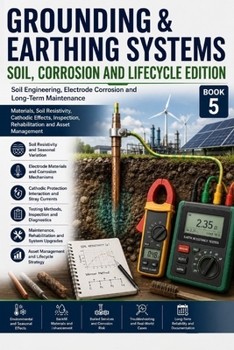
Grounding & Earthing Systems: Soil, Corrosion and Lifecycle Edition

Grounding systems do not fail only because of poor design. They also deteriorate slowly through soil changes, corrosion, moisture loss, material degradation, mechanical damage, stray currents, and years of insufficient maintenance.
Grounding & Earthing Systems: Soil, Corrosion and Lifecycle Edition is a practical engineering guide to the long-term behavior, inspection, deterioration, and rehabilitation of grounding installations. It examines what happens below the surface after commissioning and explains why a system that once performed correctly may become unsafe years later.
WHO THIS BOOK IS FOR
This book is written for:
- Electrical and power-system engineers
- Industrial electricians and maintenance technicians
- Grounding-system designers and consultants
- Electrical inspectors and safety professionals
- Substation, utility, and renewable-energy specialists
- Industrial asset and reliability managers
- Technical students seeking advanced grounding knowledge
WHAT YOU WILL LEARN
Inside this book, you will learn how to:
- Understand soil resistivity and seasonal variation
- Evaluate the effects of moisture, temperature, freezing, and soil layers
- Recognize how environmental changes affect grounding resistance
- Select electrode and conductor materials for real site conditions
- Identify galvanic, electrochemical, and stray-current corrosion
- Understand interactions with pipelines and cathodic protection
- Evaluate bentonite and other soil-enhancement materials
- Recognize mechanical, thermal, chemical, and environmental damage
- Plan periodic inspections and grounding measurements
- Interpret resistance trends instead of relying on one isolated result
- Locate hidden deterioration in buried conductors and connections
- Establish maintenance intervals based on risk and asset importance
- Rehabilitate aging systems without introducing new hazards
- Improve lifecycle documentation and asset-management decisions
TECHNICAL AREAS COVERED
The book examines the main materials, environmental conditions, measurements, and deterioration mechanisms affecting grounding systems, including:
- Soil resistivity and multilayer soil conditions
- Seasonal moisture and temperature variation
- Freezing, drying, stratification, and chemical composition
- Ground rods, grids, rings, plates, and buried conductors
- Copper, galvanized steel, stainless steel, and dissimilar metals
- Galvanic and electrochemical corrosion
- Coatings, joints, clamps, welds, and buried connections
- Stray DC currents and pipeline interaction
- Cathodic protection effects
- Bentonite and ground-enhancement compounds
- Touch voltage, step voltage, and current distribution
- Resistance, continuity, and potential-gradient measurements
- Visual inspection, excavation, trend analysis, and lifecycle records
- Rehabilitation and extension of existing grounding systems
WHY THIS BOOK MATTERS
A grounding system can show an apparently acceptable resistance while containing severely corroded conductors, weakened joints, broken electrode sections, or dangerous local voltage gradients. Reliable assessment therefore requires more than one measurement. It requires historical comparison, environmental understanding, physical inspection, and professional judgment.
Written in a practical, manufacturer-neutral style, this book connects engineering theory with realistic field conditions in substations, factories, renewable-energy installations, industrial plants, infrastructure, and utility systems.
Grounding is not a one-time installation. It is a safety asset that changes with the soil, the environment, and time.
Customer Reviews
ThriftBooks ® and the ThriftBooks ® logo are registered trademarks of Thrift Books Global, LLC
