


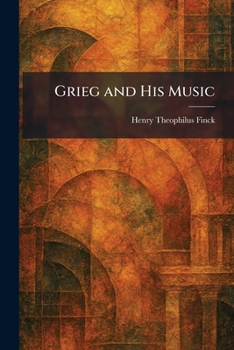
Grieg and His Music

Select Format
Select Condition 
Book Overview
"Grieg and His Music" provides an intimate and comprehensive exploration of the life and artistic legacy of Edvard Grieg, the foremost Norwegian composer of the Romantic era. Written by the esteemed music critic Henry Theophilus Finck, who was a personal friend and champion of the composer, this definitive biography delves into the unique melodic and harmonic innovations that defined Grieg's signature style. The work traces Grieg's journey from his early musical education to his international acclaim, highlighting his deep connection to Norwegian folk music and the natural landscapes of his homeland.
Readers will find detailed insights into Grieg's most celebrated works, including the "Peer Gynt" suites, the "Piano Concerto in A minor," and his extensive collection of "Lyric Pieces." Finck provides invaluable perspective on Grieg's creative process and his professional relationships with other contemporary luminaries such as Liszt and Brahms. By situating Grieg within the broader context of 19th-century nationalism, this study underscores his role in establishing a distinct Nordic musical identity. "Grieg and His Music" remains an essential resource for scholars, musicians, and enthusiasts seeking to understand the enduring charm and technical brilliance of Norway's greatest musical genius.
This work has been selected by scholars as being culturally important, and is part of the knowledge base of civilization as we know it. This work was reproduced from the original artifact, and remains as true to the original work as possible. Therefore, you may see the original copyright references, library stamps (as most of these works have been housed in our most important libraries around the world), and other notations in the work.
This work is in the public domain in the United States of America, and possibly other nations. Within the United States, you may freely copy and distribute this work, as no entity (individual or corporate) has a copyright on the body of the work.
As a reproduction of a historical artifact, this work may contain missing or blurred pages, poor pictures, errant marks, etc. Scholars believe, and we concur, that this work is important enough to be preserved, reproduced, and made generally available to the public. We appreciate your support of the preservation process, and thank you for being an important part of keeping this knowledge alive and relevant.
Customer Reviews
ThriftBooks® and the ThriftBooks® logo are registered trademarks of Thrift Books Global, LLC
