


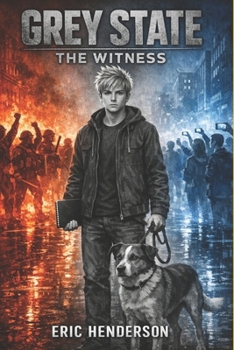
Grey State: The Witness

The world didn't split physically. It split perceptually.
Seventeen-year-old Grey Mercer wakes one morning to find his world drained of color, not just visually, but emotionally. While everyone around him sees in vibrant reds and blues, Grey sees only greyscale. While others form confident camps based on what they witnessed, Grey sees what actually happened. He becomes a rare "Grey" someone whose color perception has drained, whose emotional salience has dulled, and who can track the raw sequence of events without the filters that divide the world.
But seeing clearly doesn't make Grey powerful. It makes him unbelievable.
When a viral video captures an ambiguous moment at school, Grey watches as his classmates split into two warring camps, each certain they saw something different. One camp sees a threat. The other sees a misunderstanding. Grey sees a phone. But when he tries to point out the truth, no one believes him. His precision reads as accusation. His clarity sounds like contrarianism. His family begins to fracture along the same lines, splitting into factions that can't agree on basic facts about their own lives.
His mother schedules appointments, trying to fix what she can't understand. His father demands certainty, turning uncertainty into a respect issue. His brother probes with questions that feel like tests, searching for patterns in Grey's behavior. His sister watches, silent, asking the one question no one else will: "Why are you all so sure?"
As the days pass, Grey notices patterns everywhere: people seeing different versions of the same events, a mysterious routing code appearing on documents everywhere, his own family splitting into factions that can't agree on basic facts. When Grey tries to point out the truth, no one believes him. But he's determined to document what he sees. He starts a Sequence Log, recording timestamps, lighting conditions, hand contents, and the order of events. He notices triggers: glare on glass, compression in video, distance and blur. He tracks the patterns. He follows the paper trail.
His investigation leads him to discover that the split isn't random. There are patterns. There are codes. There's someone watching. A mysterious marking appears on medical referrals, grant documents, and utility postcards. The same subcontractor name shows up on unrelated manifests. A dead grant trail tied to visual processing research that abruptly pivots. Someone has been building something, and Grey is starting to see the edges.
When a crisis erupts at a location tied to the mysterious codes, Grey must make a choice: stay safe and let others suffer, or risk everything to act on what he sees. The Run becomes a high-intensity race against time, where Grey's ability to see clearly might be the only thing that can save lives. But even proof becomes a weapon in a world designed to split people apart.
This is not a conspiracy thriller with a mastermind reveal. This is not a "save the world" plot. This is a family drama under impossible pressure, a story about trust, belief, and what happens when your loved ones can't see what you see. The split is the setting. The family is the story.
Grey's journey from seeking approval to choosing self-trust unfolds over seventeen days that will change everything. As the world fractures around him, Grey learns that seeing the truth might be the most dangerous thing you can do. But he also discovers he's not alone. Someone else sees what he sees. Someone else is watching. And the system is larger than anyone realizes.
Perfect for readers who love thought-provoking science fiction, family dramas with impossible stakes, and stories that ask: What happens when you can see the truth, but no one will believe you?
Customer Reviews
ThriftBooks® and the ThriftBooks® logo are registered trademarks of Thrift Books Global, LLC
